3D CMZ V: A new orbital model of our Galaxy's Center, informed by data across the electromagnetic spectrum

3D CMZ V: A new orbital model of our Galaxy's Center, informed by data across the electromagnetic spectrum
Dani R. Lipman, Cara Battersby, Daniel Walker, Maïca Clavel, B. L. DuBois, Adam Ginsburg, Jonathan D. Henshaw, Ralf S. Klessen, Elisabeth A. C. Mills, Francisco Nogueras-Lara, Mattia C. Sormani, Robin G. Tress
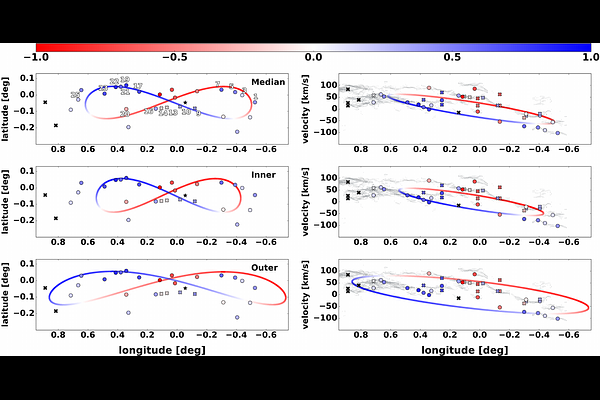
AbstractThe 3D structure of The Milky Way's Central Molecular Zone (CMZ) informs our understanding of star formation cycles, black hole accretion, and the evolution of galactic nuclei. However, a comprehensive 3D model has remained elusive, as no singular dataset nor theory contains the requisite information to describe the orbital motion of the gas. We implement a Bayesian framework to flexibly combine datasets across the electromagnetic spectrum for molecular clouds in our CMZ catalog. We develop near/far metrics for each dataset, including dust extinction, absorption, stellar densities, X-ray echoes, and proper motions; and report a posterior positional probability density function (PPDF) for each cloud. We then use the posterior PPDF distributions for all CMZ clouds to search for a best fitting x$_2$ orbit. We find that no single orbit is a perfect fit, but the structure can overall be represented by nested x$_2$ orbits, with major axes ranging from about $72 < a < 146$ pc. We also present projected line of sight distance estimates for all 31 clouds in the catalog. Our results highlight asymmetries along the line of sight, with most clouds lying on the near side of the Galactic Center, and agree overall with current near/far assumptions for most CMZ clouds, including those in the Sgr A region, which may be much closer to the center. We conclude that the CMZ can be well-described by x$_2$ orbital families, and that the overall gas distribution is more complex than a single closed or open elliptical orbit.