Unified Formation Channel of Hot and Warm Jupiters via Planet-Planet Scattering

Unified Formation Channel of Hot and Warm Jupiters via Planet-Planet Scattering
Julia Esposito, Gongjie Li, Songhu Wang
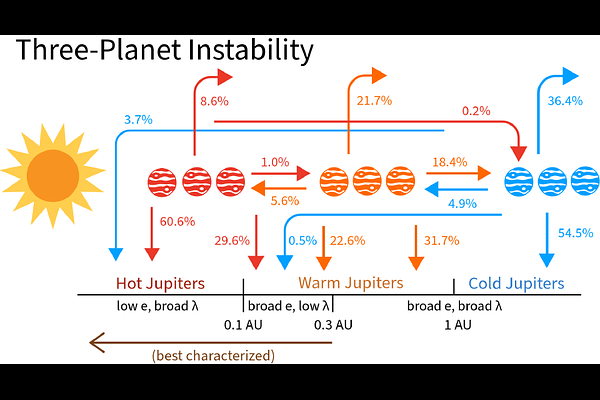
AbstractRecent observations show distinct orbital architectures for hot and warm Jupiters: hot Jupiters span a wide range of stellar obliquities and tend to host distant companions without close-by companions, whereas warm Jupiters are often aligned and accompanied by both close-by and distant companions. In this paper, we revisit planet-planet scattering and demonstrate that it provides a unified framework for both populations. Using N-body simulations with tides, we explore three regimes: hot (a_1 < 0.1 AU), warm (0.1 < a_1 < 1 AU), and cold (1 < a_1 < 10 AU) scattering. Hot scattering predominantly produces compact hot-Jupiter pairs, which are rarely observed, implying this channel is rare. Cold scattering readily produces retrograde hot Jupiters and likely constitutes a main reservoir feeding the hot-Jupiter population. However, cold scattering produces few inner warm Jupiters at a at about 0.1-0.3 AU. We show that warm scattering naturally fills this gap: high-inclination inner warm Jupiters produced by warm scattering are preferentially removed through further eccentricity excitation followed by tidal circularization into hot Jupiters. As a result, the surviving inner warm Jupiters are biased toward a broad range of eccentricities but modest inclinations, producing the observed "eccentric-but-aligned" population. This story makes testable predictions: (i) warm Jupiters, especially at a >~ 0.3 AU, should not be exclusively aligned, and (ii) warm Jupiters should often host nearby companions with non-negligible mutual inclinations up to <~ 30 degrees.