Generalising gravitationally induced decoherence beyond linear environmental interactions in a microscopic quantum mechanical toy model

Generalising gravitationally induced decoherence beyond linear environmental interactions in a microscopic quantum mechanical toy model
Max Joseph Fahn, Renata Ferrero, Kristina Giesel, Roman Kemper
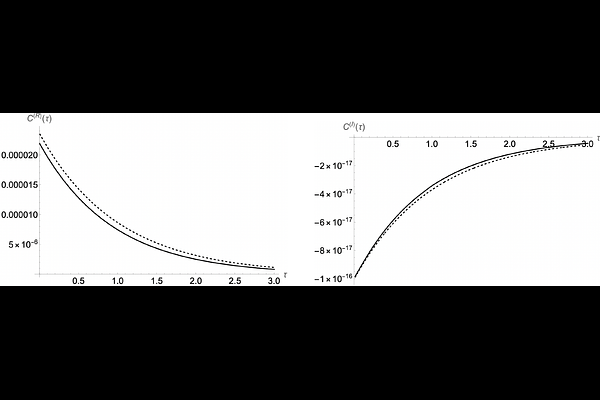
AbstractWe generalise the quantum mechanical toy model for gravitationally induced decoherence presented in Xu, Blencowe (2022) and Domi et al. (2024). In contrast to earlier formulations, in which the Hamiltonian of the system of interest is linearly coupled to the position operators of the oscillators in the environment, we consider an interaction formulated in terms of Weyl elements of the environment's position operators. This extension is motivated by polymer quantum mechanics, in which Weyl elements are fundamental operators, as well as by the possibility of generating non-linear interactions through suitable truncations of the exponential Weyl elements. Here we focus on a sinus-like coupling that is still quantised using the Schrödinger representation and, in the limit of a small Weyl parameter, reproduces the conventional linear interaction. To derive the corresponding master equation, we developed two complementary methods for the analytical calculation of the environmental correlation functions. The first utilises Wick's theorem for thermal expectation values in conjunction with annihilation and creation operators, while the second is based on the short-time Fourier transform and completely avoids the use of annihilation and creation operators, making it more readily transferable and generalisable to a polymer quantisation. Both approaches yield identical results. We further generalise the spectral density required for the exponential coupling structure. A numerical analysis shows that the environmental correlation functions decay rapidly with time, which supports the validity of the Markov approximation. Using a Taylor expansion in the Weyl parameter, we show that the first-order term reproduces the decoherence model of Xu, Blencowe (2022) and Domi et al. (2024). Finally, we derive the solution to the renormalised master equation.