Inferring Unreported Measurement Uncertainties via Information Geometry in Astrophysics

Inferring Unreported Measurement Uncertainties via Information Geometry in Astrophysics
Marko Imbrišak, Krešimir Tisanić
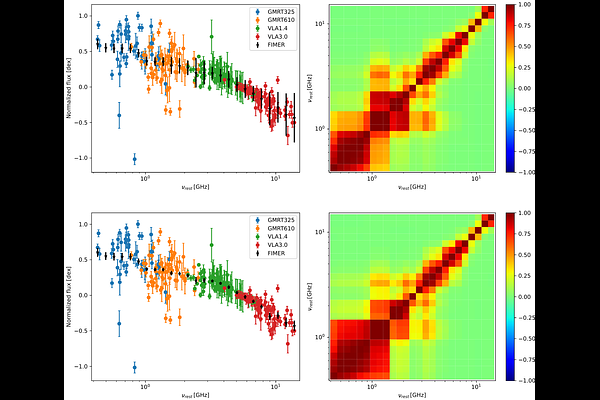
AbstractModern radio and multi-instrument astrophysical datasets are increasingly assembled from surveys with different sensitivities and selection effects. In such heterogeneous datasets, published measurement uncertainties are often incomplete, non-uniform across subsets, or missing cross-correlation information altogether. This limits reliable statistical inference, since underestimated or inconsistently modeled uncertainties can distort fitted spectral shapes, bias parameter estimates, and obscure physically meaningful structure. We introduce the Fisher Information Metric Error Reconstruction (FIMER), an information-geometric framework for reconstructing effective measurement uncertainties directly from heterogeneous astrophysical data. FIMER combines weighted Fisher-information geometry, FBET and an adaptive discrete hyperparameter search, while incorporating prior statistical knowledge of detector behavior into the weighting procedure. The priors used are not chosen as arbitrary tuning prescriptions or uninformative regularizers; they are motivated by statistical properties of the underlying detection process. Poisson priors represent counting-statistics behavior, while extreme-value priors allow tail-dominated fluctuations to be incorporated when rare or asymmetric excursions are expected to influence the inferred uncertainty distribution. We apply FIMER to radio SEDs of RxAGN using COSMOS VLA data at 1.4 and 3 GHz together with GMRT data at 325 and 610 MHz. The results show that FIMER provides a practical route to uncertainty reconstruction in heterogeneous survey combinations, especially when reported uncertainties are unavailable, underestimated, or strongly correlated. The method is particularly relevant for archival and multi-survey astrophysical datasets, where full covariance information is rarely available but reliable statistical inference remains essential.