Statistical Field Theory for Weak Gravitational Lensing

Statistical Field Theory for Weak Gravitational Lensing
Zheng Zhang, Philip Bull, Chris Clarkson, Andrina Nicola
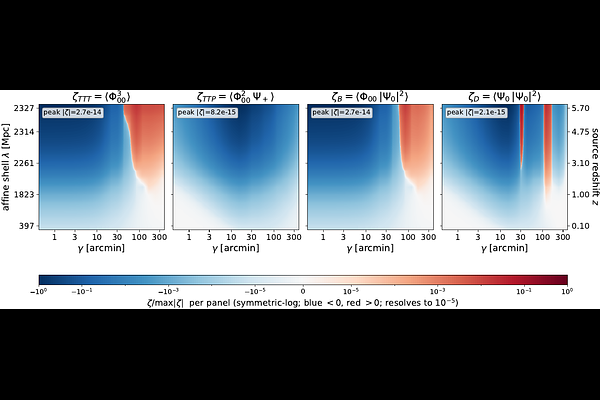
AbstractStandard weak-lensing calculations treat lensing as a linear remapping of the matter field along the line of sight. We instead formulate lensing as a stochastic field theory for the Sachs optical scalars, driven by random Ricci-focusing and Weyl-shearing fields. The resulting path integral generates a diagrammatic expansion for arbitrary $n$-point correlation functions of lensing observables, organised into linear response, nonlinear propagation, and driving-field cumulants. The conventional calculation emerges as the lowest-order, linear-propagation limit. Beyond it, nonlinear Sachs evolution couples to driving-field non-Gaussianity, mixing the matter cumulant hierarchy into the lensing hierarchy. A selection rule governs the couplings: an $n$-point observable receives a direct contribution from the $n$-point driving-field cumulant, and its leading hierarchy-mixing correction from the $(n+1)$-point cumulant via one nonlinear Sachs interaction, with higher cumulants entering only at higher order. The two-point function, for instance, is corrected by squeezed three-point cumulants of Ricci focusing and Weyl shearing, letting small-scale modes source larger scales and feeding the lensing $E$- and $B$-modes equally. Rather than a restrictive approximation scheme, the formalism is a paradigm shift: a unified framework naturally accommodating path corrections, higher-order matter statistics, stochasticity, and small-scale effects.