Kinetic Processes to Radio Burst: First Observational-driven Study in Coronal Loops

Kinetic Processes to Radio Burst: First Observational-driven Study in Coronal Loops
Mehdi Yousefzadeh, Marian Karlicky, Artem Koval, Alena Zemanova, Yao Chen, Jun Lin
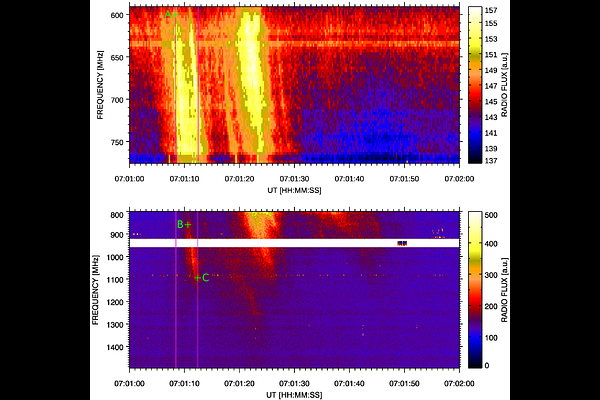
AbstractUnderstanding the origin of coherent solar radio bursts requires linking macroscopic coronal structures with the kinetic processes responsible for wave generation. We investigate emissions from slowly positively drifting bursts (SPDBs), a specific type of solar radio emission. SPDBs provide observational constraints for modeling beam-plasma interactions in coronal loops, serving as a basis for a multiscale description. We employ a three--stage numerical framework that combines nonlinear force--free field (NLFFF) magnetic extrapolation, guiding--center simulations, and fully kinetic particle--in--cell (PIC) modeling. The background plasma density is described using a hydrostatic model consistent with active--region conditions, producing a plasma--frequency gradient comparable to that inferred from the observed SPDBs spectrum. Energetic electrons injected near the loop top evolve through magnetic mirroring, pitch--angle scattering, turbulence development, and partial precipitation. Evolved velocity distribution functions (EVDFs) are sampled after approximately one bounce period and used in PIC simulations to evaluate emission properties. The results show that the evolved beam distribution of energetic electrons predominantly excites beam--Langmuir waves and fundamental plasma emission along the loop, with the emission intensity gradually decreasing from the loop top toward the footpoint. The modest initial beam velocity of energetic electrons explains the inefficient generation of harmonic plasma emission. The temporal evolution of the modeled emission reproduces key SPDB characteristics, including the ~ 4s duration and frequency drift behavior. These results suggest plasma emission explains the mechanisms behind SPDB generation and demonstrate the feasibility of a unified model connecting coronal magnetic topology, particle transport, and radio emission.