Subsurface ocean salinity and dissipation rate inferred from Enceladus ice shell morphology

Subsurface ocean salinity and dissipation rate inferred from Enceladus ice shell morphology
Wanying Kang, Yixiao Zhang
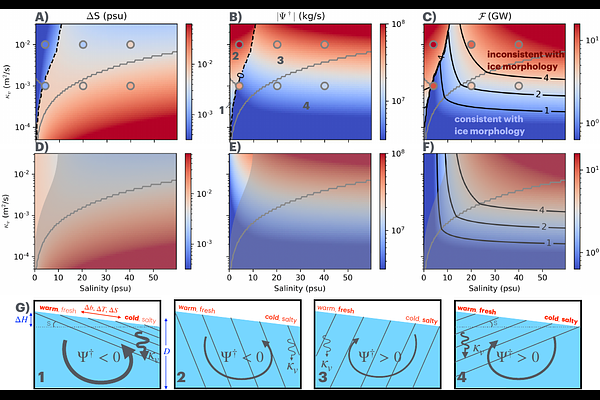
AbstractThe habitability of Enceladus' subsurface ocean and the detectability of potential biosignatures depend on efficient ocean circulation and suitable ocean conditions. Directly probing the ocean is challenging because it lies beneath a thick ice shell; however, the ice thickness distribution is relatively well constrained and provides indirect insight into the underlying ocean dynamics. This study investigates how ocean circulation and the associated heat transport depend on ocean salinity and tide-induced vertical mixing using scaling analysis, supported by numerical simulations. We find that ocean circulation and equatorward heat convergence are stronger under extremely high or low salinity conditions than under intermediate salinity, and both increase with tidal mixing rates. Because the poleward thinning of Enceladus' ice shell cannot be maintained in the presence of strong equatorward ocean heat transport, these results place constraints on the ocean salinity, diffusivity, circulation timescale, and ocean dissipation rate. Energetic analysis further shows that Enceladus' ocean behaves like an extremely efficient heat pump (inefficient heat engine), potentially transporting up to 1000 times more heat across latitudes than the energy dissipated within the ocean itself, thereby placing strong constraints on the ocean's energy dissipation rate.