The SRG/eROSITA diffuse soft X-ray background II. spectra and morphology of the eROSITA bubbles in the western Galactic hemisphere

The SRG/eROSITA diffuse soft X-ray background II. spectra and morphology of the eROSITA bubbles in the western Galactic hemisphere
Michael C. H. Yeung, Martin G. F. Mayer, Andy Strong, Michael J. Freyberg, Gabriele Ponti, Konrad Dennerl, Junjie Mao, Manami Sasaki, Xueying Zheng, Jeremy S. Sanders, Yi Zhang, Jiejia Liu, Liyi Gu, Werner Becker, Frank Haberl, Teng Liu, Andrea Merloni, Peter Predehl
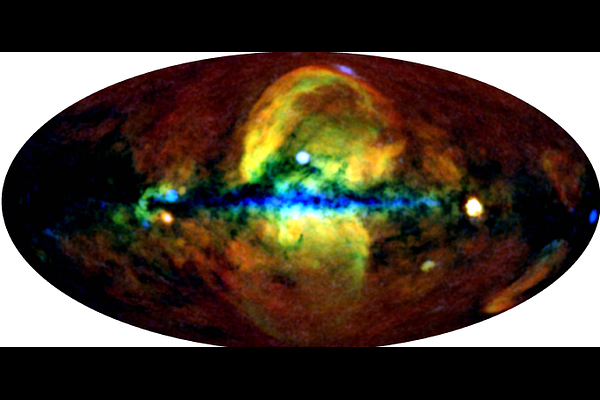
AbstractThe eROSITA bubbles (eRObub) were discovered in 2020 in the first SRG/eROSITA All-Sky Survey, and are among the most extended structures in the X-ray sky. Using eROSITA all-sky maps and spatially resolved spectra, we aim to infer the three-dimensional structure and measure the hot gas properties of the eRObub. We fit spectra binned to a constant S/N and high-S/N spectra from custom regions to examine gas properties in more detail. We fit the morphology of eRObub with a parametrised geometrical model that describes a blast wave propagating into an idealised Galactic halo from the centre. We found the interior of the western eRObub is best characterised by two emission components with relatively uniform temperatures: a hotter component at $kT=0.60\pm0.02$ keV, and a colder one at $kT=0.21^{+0.03}_{-0.01}$ keV, where the latter's emission measure is about five times higher on average. Our spectra suggest sub-solar abundances ($Z=0.2\pm0.1 Z_\odot$), consistent with expectations for the Galactic halo, while we find no conclusive evidence for $α$-element enhancement. In contrast, the North Polar Spur exhibits higher abundances ($Z>0.5 Z_\odot$), which, at face value, disfavours a common origin. We spectrally confirm an apparent cool shell at $kT\sim0.18$-$0.2$ keV surrounding the northern eRObub, assuming collisional ionisation equilibrium. We found no noticeable difference in X-ray emission in regions overlapping with the Fermi Bubbles. Our geometrical model suggests that the horizontal size of both eRObub is well-constrained (semi-minor axis $\sim 6$ kpc), but their vertical extent is uncertain, as the observed X-ray emission is almost insensitive to the existence and location of a bubble cap. Additionally, a tilt ($\sim 30^{\circ}$) towards $l\sim 220^{\circ}$ is needed to reproduce the projected image of the northern eRObub, whereas the southern bubble requires little tilt.