Correctness-Dependent Asymmetric Target Distributions for Self-Distillation Policy Optimization

Correctness-Dependent Asymmetric Target Distributions for Self-Distillation Policy Optimization
Suwan Yoon, Seongryong Jung, Changhee Lee
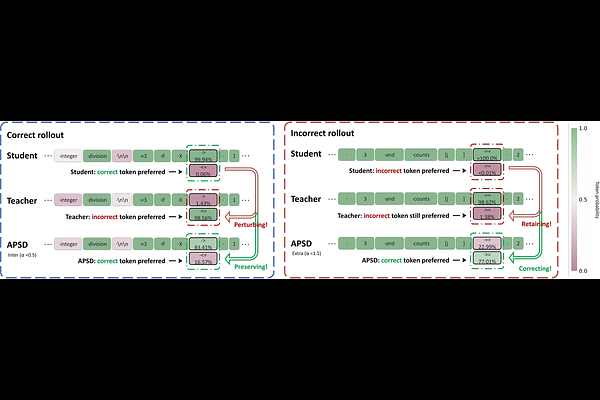
AbstractSelf-distillation policy optimization provides dense token-level supervision for LLM post-training through feedback-conditioned self-teachers. However, directly matching the self-teacher can disrupt successful behaviors on correct rollouts while providing insufficient correction on incorrect ones. We propose Asymmetric Policy Optimization via Self-Distillation (APSD), which constructs correctness-dependent targets by mixing student and self-teacher distributions: interpolation preserves successful behaviors on correct rollouts, while extrapolation beyond the self-teacher strengthens correction on incorrect ones. We analyze APSD through divergence decomposition, reverse-KL barycentric geometry, and gradient analysis, highlighting the importance of gradient flow through student-dependent targets. Experiments under reinforcement learning with verifiable rewards and rich feedback show that APSD achieves strong overall performance against reinforcement-learning and self-distillation baselines and matches SDPO performance with 2.6x fewer training steps on average across Qwen3 model scales.