Nitrogen rises to the top: evidence of enhanced mixing in very massive stars

Nitrogen rises to the top: evidence of enhanced mixing in very massive stars
Pablo Marchant, Tomer Shenar
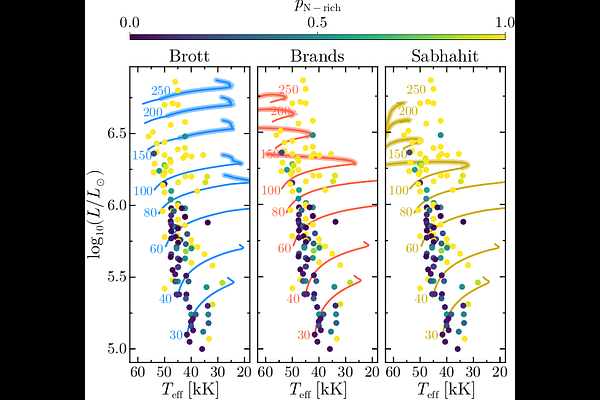
AbstractRecent observations of young galaxies in the high-redshift Universe reveal signs of early enrichment of nitrogen. Extremely massive stars ($M \gtrsim 10^{2}-10^3\,M_\odot$) with strong stellar winds have been proposed as a potential driver of this phenomenon. Here, we show that the observed fraction of nitrogen rich stars with masses $\gtrsim 100M_\odot$ cannot be explained solely by mass loss, requiring significantly more efficient mixing beyond their convective cores than accounted in present evolutionary models. We compile a representative sample of 122 stars in the Tarantula Nebula of the Large Magellanic Cloud (LMC) with masses $M \gtrsim 30\,M_\odot$. Nearly all stars with masses $M \gtrsim 100\,M_\odot$ exhibit strong nitrogen enrichment, by factors $\gtrsim 5-10$. We demonstrate that this trend cannot be reproduced by varying assumptions on binary fraction, star formation history, or mass-loss rates within ranges predicted by current empirical and theoretical models. In contrast, enhanced core overshooting of $α_\text{ov}\gtrsim 1$ can account for the observed enrichment, but leads to quasi-chemically homogeneous evolution that is inconsistent with the observed Hertzsprung-Russell diagram. While the origin of this discrepancy remains unclear, our results, in combination with observational and theoretical constraints on mass-loss rates, suggest the presence of efficient early mixing operating during or shortly after the formation of very massive stars. Such mixing models are currently not included in stellar evolution models. These findings have immediate implications for the formation, radial expansion, evolution, and final fates of stars at the upper mass end, and provide a potential pathway to explaining the rapid nitrogen enrichment observed in the high-redshift Universe.