Early changes of ER-mitochondrial interaction in the liver of high-fat diet-fed mice

Early changes of ER-mitochondrial interaction in the liver of high-fat diet-fed mice
Malecka, J.; Chrostek, G.; Casali, C.; Pessolano, E.; Mantovani, E.; Clemente, N.; Reano, S.; Pinton, G.; Biggiogera, M.; Tapella, L.; Chiazza, F.; Dematteis, G.; Lim, D.
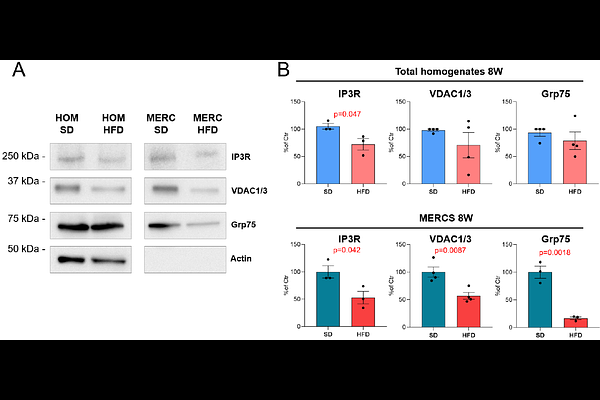
AbstractIP3R-Grp75-VDAC1 protein complex at the mitochondria-ER contact sites (MERCS) is involved in response to nutrients and control of glucose and energy metabolism, however, early alterations of the complex and MERCS in response to increased fat intake remain inconclusive. We investigated early effects of high-fat diet (HFD) on IP3R-Grp75-VDAC1 protein expression in correlation with ER-mitochondrial interaction in the liver of mice. Five-week-old mice were fed an HFD or a standard diet (SD) for 2 weeks (2W) or 8 weeks (8W). MERCS fractionation by a gradient ultracentrifugation, Western blot, transmission electron microscopy (TEM), Oroboros high-resolution respirometry were used to analyse liver tissues, while real-time PCR was used to profile genes responsive to HFD. No macroscopic morphological or functional alterations were observed in mice at 2W, while, expectedly, at 8W of HFD mice gained weight and glucose intolerance. Total IP3R protein was reduced at both 2W and 8W points by a post-transcriptional mechanism, while in MERCS, IP3R, VDAC1 and Grp75 were reduced at 8W time-point. TEM analysis revealed a significant reduction of mitochondrial coverage by MERCS, mitochondrial fragmentation and shortening of ER-mitochondria distance already at 2W time-point. Mitochondrial function and metabolism were largely spared. Markers of altered protein homeostasis such as Lmp2, Mecl-1 and Lmp7 showed an early upregulation. In conclusion, HFD induces early alterations in liver MERCS that precede gain of weight and glucose intolerance, suggesting their primary role in obesity and metabolic diseases and as potential therapeutic target.