Individualized Functional Connectivity-Guided TMS Targeting Theory of Mind Network for Autism Spectrum Disorder

Individualized Functional Connectivity-Guided TMS Targeting Theory of Mind Network for Autism Spectrum Disorder
Zhao, N.; Zhang, B.; Wang, X.-Q.; He, H.; Li, P.; Che, X.-W.; Cash, R.; Laureys, S.; Sun, L. S.; Zang, Y.-F.; Yuan, L.-X.
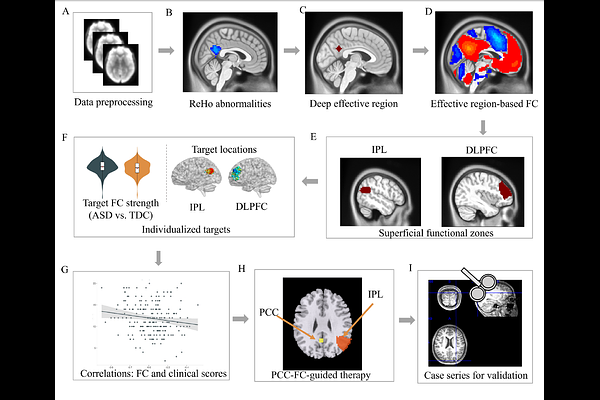
AbstractTranscranial magnetic stimulation (TMS) shows promise in autism spectrum disorder (ASD), but variable outcomes may reflect suboptimal targeting. We developed a functional-connectivity (FC)-guided individualized TMS approach by identifying an ASD-relevant effective region and selecting superficial targets. In a multi-site mega-analysis of Autism Brain Imaging Data Exchange I data (298 ASD, 348 controls), the region with the greatest regional homogeneity (ReHo) abnormality was defined as the effective region. Individualized dorsolateral prefrontal cortex (DLPFC) and inferior parietal lobule (IPL) targets were localized as sites with strongest FC to this region. Group differences, symptom associations, and a six-patient case series were examined. The posterior cingulate cortex (PCC) showed the greatest ReHo abnormality and was implicated in theory-of-mind (ToM) circuitry. PCC-guided targets showed weaker FC in ASD in the right IPL, correlating with Autism Diagnostic Interview social scores; left DLPFC FC differences lacked symptom associations. In the case series, individualized PCC-IPL-guided TMS reduced ToM-related symptoms and Childhood Autism Rating Scale scores. PCC-IPL FC-guided TMS is a biologically informed intervention for modulating ToM circuitry in ASD.