Continuous Nuclear Export of p62/SQSTM1 Is Essential for Kidney Homeostasis

Continuous Nuclear Export of p62/SQSTM1 Is Essential for Kidney Homeostasis
Ning, B.; Kawanishi, K.; Kang, D.; Tatsuno, R.; Usui, T.; Morito, N.; Yanagawa, T.; Mizuno, S.; Takahashi, S.; Warabi, E.
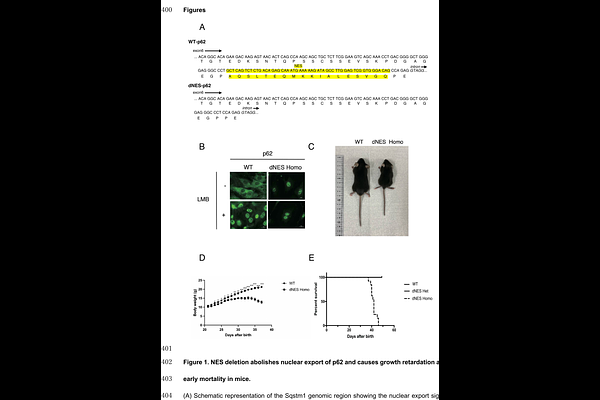
AbstractThe selective autophagy receptor p62/SQSTM1 dynamically shuttles between the nucleus and cytoplasm through distinct nuclear localization and export signals, yet the physiological significance of this trafficking has remained unknown. Here, we generated mice carrying a deletion of the p62 nuclear export signal (dNES) to determine the in vivo role of p62 nuclear export. Homozygous dNES mice developed progressive podocyte injury, glomerulosclerosis, and fatal renal failure by 6-7 weeks of age, whereas heterozygous and dNES/- mice did not develop renal dysfunction. Loss of nuclear export caused constitutive nuclear accumulation of p62, accompanied by the formation of insoluble ubiquitin-positive aggregates and widespread alterations in the renal proteome, including activation of energy metabolism-related pathways and suppression of developmental programs. We previously demonstrated that the lipid peroxidation product 4-hydroxy-2-nonenal (4-HNE) inhibits the nuclear export receptor XPO1, resulting in nuclear retention of p62 in cultured cells. The present findings provide in vivo evidence that continuous nuclear export of p62 is indispensable for maintaining kidney homeostasis and reveal that excessive nuclear accumulation, rather than cytoplasmic depletion, underlies p62-mediated toxicity. Collectively, these findings establish continuous nuclear export of p62 as an essential mechanism for maintaining kidney homeostasis. Significance StatementThe adaptor protein p62/SQSTM1 continuously shuttles between the nucleus and cytoplasm, but the physiological significance of this trafficking has remained unknown. Here, we show that disrupting the nuclear export signal of p62 causes progressive podocyte injury, glomerulosclerosis, and fatal kidney failure through excessive nuclear accumulation and aggregate formation. In contrast, dNES/+ and dNES/- mice remain healthy, demonstrating that excessive nuclear accumulation, rather than cytoplasmic depletion, drives disease. These findings identify continuous nuclear export as a fundamental mechanism that prevents toxic nuclear accumulation of p62 and preserves kidney homeostasis.