Time-frequency EEG markers of word boundaries in speech production

Time-frequency EEG markers of word boundaries in speech production
Eustace, S. D.; Guediche, S.; Brasiello, L.; Rocha, M.; Correia, J. M.
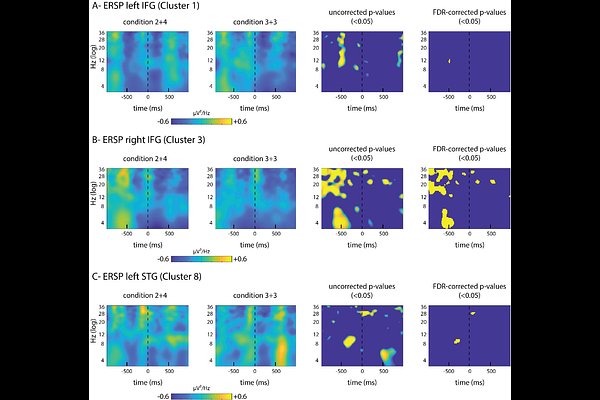
AbstractSpeech production requires orchestration of multiple brain systems, including cortical and subcortical areas that support the unfolding of the spoken message across hierarchical linguistic levels, such as phonemes, syllables, words or phrases. Transitions between levels are critical for fluent speech, yet the neural dynamics of, for example, syllable-level and word-level transitions remain unknown. In this electroencephalography (EEG) study, we use time-frequency analysis and source localization to determine differences associated with word-boundary vs. within-word syllable transitions. To this end, pseudoword pairs comprising six consonant-vowel (CV) syllables with different word-boundary positions were used. Fluent human adults produced the utterances at the rhythm of a learned visual metronome (i.e., syllable-by-syllable), such that each syllable was uttered at matching times independently of its relative word position. Accordingly, a target syllable could be either a within-word syllabic transition or a between-word transition, while other linguistic properties, including articulation, stress pattern, co-articulation or prosody, were matched. EEG time-frequency analyses of neural sources successfully revealed sensitivity to hierarchical structure. Neural sources in left and right inferior frontal lobes, as well as left superior temporal lobe were differentially recruited when producing the same exact syllables, in the same exact utterance position, but under different word boundary contexts. A right inferior frontal source showed a robust time-frequency modulation in word transitions that included elevated event-related synchronization in the theta and beta range. Interestingly, despite our efforts to control speech pace across conditions using metronome-based guidance, small, albeit significant timing delays emerged, confirming higher cognitive demands at word boundaries.