The influence of tension-compression switches on brain anisotropic modelling

The influence of tension-compression switches on brain anisotropic modelling
Li, C.; Zhou, Z.
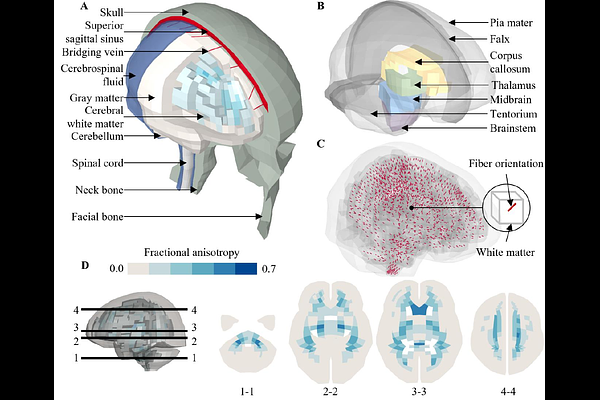
AbstractFinite element (FE) head models are valuable tools for investigating brain injury mechanics, with their reliability critically dependent on accurate material modelling. White matter (WM) is often considered mechanically anisotropic due to its aligned axonal fiber architecture and is commonly represented using fiber-reinforced hyperelastic formulations such as the Gasser-Ogden-Holzapfel (GOH) model. A fundamental assumption of the GOH model is that fibers contribute only in tension and not in compression, requiring the use of tension-compression switches. However, inconsistencies were noted in the formulation of tension-compression switches with the influence on computational biomechanics unknown. To address this knowledge gap, three commonly used switching schemes - differing in both the switching parameter and the treatment of compressed fibers - were theoretically elaborated and numerical implementation within the GOH framework to simulate the mechanical anisotropy of WM in impact simulations. Results from the case-based and group-level analyses demonstrated that both the switching parameter and the treatment of compressed fibers affected WM deformation. Significant cross-scheme strain differences were noted in the first principal strain at the element level and fiber strain at the fiber level. These findings highlighted the mechanical role of tension-compression switch in the GOH-based brain modelling and advocated the adoption of fiber stretch itself as the switching parameter to discriminate the tensile and compressive fibers. The current study provides important guidance for the anisotropic constitutive models in brain tissue and calls for direct verification of the tension-compression switch hypothesis in axonal fibers.