Phase resetting of in-phase synchronized Hodgkin-Huxleydynamics under voltage perturbation reveals reduced null space

Phase resetting of in-phase synchronized Hodgkin-Huxleydynamics under voltage perturbation reveals reduced null space
Gupta, R.; Karmeshu, ; Singh, R. K. B.
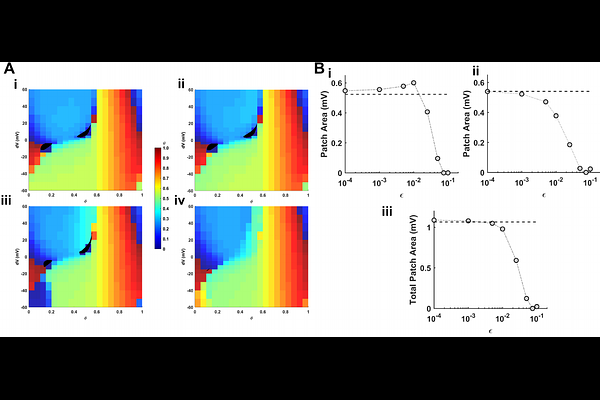
AbstractVoltage perturbations to a repetitively firing Hodgkin-Huxley (HH) model of neuronal spiking in the bistable regime with coexisting limit cycle and stable steady node can either lead to the spike's phase resetting or collapse to the stable steady state. The latter describes a non-firing hyperpolarized quiescent state of the neuron despite the presence of constant external current. Using asymptotic phase response curve (PRC), the impact of voltage perturbations on a repetitively firing HH model is studied here while it is diffusively coupled to another HH model under identical external stimulation. It is observed that the pre-perturbation state of synchronization and the coupling strength critically determine the PRC response of the perturbed HH dynamics. Higher coupling strengths of perfectly in-phase (anti-phase) synchronized HH models shrink (expand) the combinatorial space of perturbation strengths and the oscillation phases causing collapse to the quiescent state. This indicates reduced (enlarged) basin of attraction, viz. the null space, associated with the steady state in the HH phase space. The findings bear important implications to the spiking dynamics of diverse interneurons, as well as special cases of pyramidal neurons, coupled through electrical synapses via. gap junctions, and suggest the role of gap junction plasticity in tuning vulnerability to quiescent state in the presence of biological noise and spikelets.