Physiological responses of submerged freshwater macrophytes to multiple stressors

Physiological responses of submerged freshwater macrophytes to multiple stressors
Mahdjoub, A. M.; Einspanier, S.; Gross, E. M.; Hilt, S.
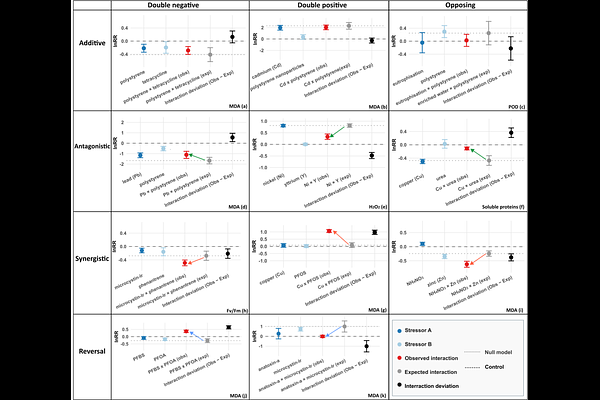
AbstractSubmerged macrophytes are central to freshwater ecosystems functioning but are declining globally under multiple anthropogenic stressors. We aimed to identify general patterns in physiological responses and interaction types, and to assess whether a mechanistic understanding of stressor interactions can be developed from published evidence. We systematically reviewed 12,858 records, identified 172 relevant papers, and extracted effect sizes from 124 experiments included in the meta-analysis. Most studies examined combinations of nutrient enrichment, shading, toxic trace metals, warming, and emerging contaminants such as PFAS and microplastics, typically under simplified 2 x 2 factorial laboratory designs. Additive effects dominated (50%), while synergistic interactions were relatively infrequent (14%). Antagonistic interactions often reflected dominance of a single stressor or compensatory responses, whereas synergisms were most frequent with metals combined with co-stressors enhancing bioavailability. Our synthesis suggests that accumulated stressors cause negative, but not necessarily amplified, responses, although the limited number of experiments testing more than two stressors means synergistic effects may be underestimated. We propose Stuckenia pectinata as a model organism because of its cosmopolitan distribution, experimental tractability, and available genomic resources, and argue that expanding stressor complexity, duration, and taxonomic breadth will strengthen predictions of macrophyte responses and inform freshwater conservation under global change.