Latitudinal diversity gradients and selective microbialexchange at the Atlantic ocean-air interface

Latitudinal diversity gradients and selective microbialexchange at the Atlantic ocean-air interface
Hrabe de Angelis, I.; Ruff, S. E.; Aardema, H. M.; Basic, S.; Bruewer, J. D.; Slagter, H. A.; Weber, J.; Calleja, M. L.; Cardon, Z. G.; Dragoneas, A.; Leifke, A. L.; Nilius, B.; Raj, S. S.; Walter, D.; Weber, B.; Fuchs, B. M.; Haug, G. H.; Poeschl, U.; Schiebel, R.; Poehlker, C.
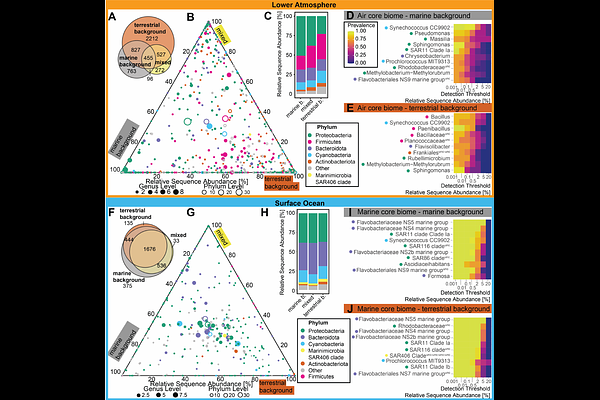
AbstractMicrobial communities at the ocean-atmosphere interface play a vital role in nutrient, aerosol, and water cycling, yet their large-scale biogeography remains scarcely studied. Here we assessed microbial cell abundance and community structure in air and surface ocean samples along a 14,400 km transect from the polar circle to the equator. Air and surface ocean microbiomes were taxonomically distinct across the North East Atlantic. The microbiome in the air had a lower local community richness compared to the surface ocean, yet was more diverse across larger geographical scales. Our results suggest that terrestrial-derived air masses affected air and surface ocean communities. Air microbial communities showed a latitudinal diversity gradient with richness and cell abundance increasing from the polar circle to the equator. We observed an exchange of microbial lineages between ocean and air, however, most lineages were confined to one realm, suggesting lineage-selective aerosolization and deposition of microbial cells.