Vertical inheritance and loss-driven evolution of secretion systems in the bee gut microbiota

Vertical inheritance and loss-driven evolution of secretion systems in the bee gut microbiota
Acheampong, S. A.; Kwong, W. K.
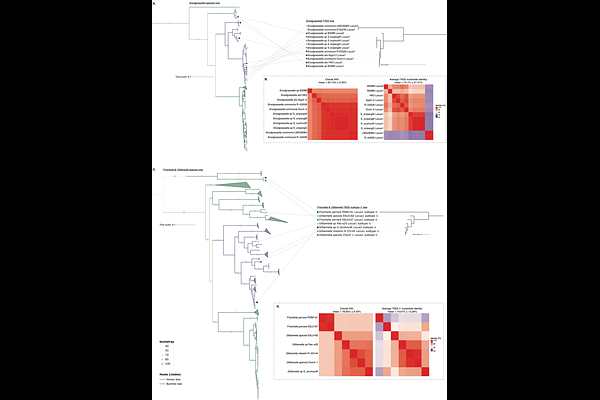
AbstractThe stability of gut bacterial communities is determined by complex inter-cellular interactions such as competition, cooperation and host dynamics. A mechanism proposed to mediate these interactions is bacterial secretion systems: specialized protein complexes that secrete effector molecules into neighbouring cells or the surrounding environment to influence community stability. However, the forces driving secretion system distribution and evolution in host-associated microbiomes remain unclear. Here, we show that secretion systems in the bee gut microbiome are predominantly vertically inherited and evolve primarily through recurrent gene loss rather than horizontal acquisition. Using comparative genomic analysis, we found that bee gut symbionts mostly encode type I, V, and VI secretion systems. In contrast, the pathogen-associated type II and III systems are missing, but they retain evolutionarily related pili and flagella. We found weak association between the presence of specific secretion systems and the bee hosts, suggesting that these systems are maintained for interbacterial interactions rather than host-specific adaptation. Co-phylogenetic analyses show congruence between bacterial strain phylogenies and most secretion system phylogenies, indicating a vertical mode of transmission. Only a subtype of the type VI system in the Orbaceae and the type IV system in Snodgrassella spp. show evidence of horizontal transmission. The lack of horizontal transfers means that losses of secretion systems is a permanent evolutionary event in almost all lineages of the bee gut microbiota. Our study provides a uniquely comprehensive analysis of secretion systems across an entire gut bacterial community, giving insight into how microbiomes evolve and maintain functional interactions within host-associated environments.