In planta-specific transcriptional regulatory circuit regulates expression of MoHTR1, a nuclear effector gene of Magnaporthe oryzae

In planta-specific transcriptional regulatory circuit regulates expression of MoHTR1, a nuclear effector gene of Magnaporthe oryzae
Yoon, Y.-J.; Lee, H.; Kim, S.; Chung, H.; Khang, C. H.; Lim, Y.-J.; Lee, Y.-H.
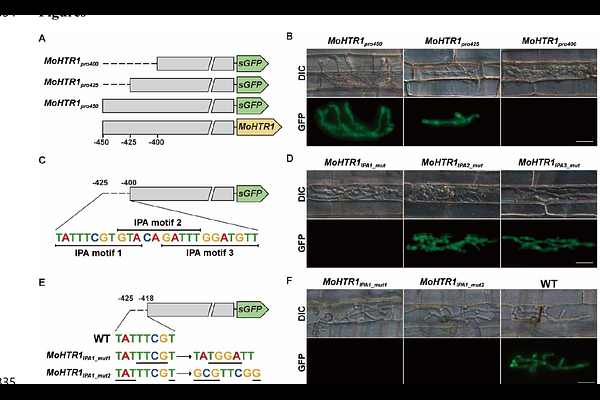
AbstractDuring host-pathogen interactions, fungal pathogens secrete effector proteins into host cells to manipulate the host immune system and facilitate infection. Although many effector genes are highly expressed during infection stages, there is limited information on the mechanisms regulating their in planta expression. Here, we characterize the promoter of MoHTR1, a nuclear effector gene of the rice blast fungal pathogen, to elucidate its in planta-specific expression. Using promoter deletion and mutation analyses, we identified a core cis-element (TATTTCGT) within the MoHTR1 promoter, designated the in planta active (IPA) element, which is crucial for in planta-specific expression. The IPA element is responsible for the expression of not only MoHTR1, but also other effector genes including a known effector Slp1. Furthermore, the IPA element enables the in planta expression of MobZIP14, a gene specifically expressed during vegetative growth. The IPA element plays a critical role in fungal virulence by enabling MoHTR1 expression and regulating host immune responses. Bioinformatic and DNA-protein interaction analyses revealed that RGS1, a transcription factor containing a winged-helix binding domain, acts as a transcriptional regulator of MoHTR1 by directly binding to the IPA element. Our findings provide new insights into the regulatory mechanisms driving the in planta-specific expression of fungal effector genes.