Testing hypotheses about correlations between brain activation patterns

Testing hypotheses about correlations between brain activation patterns
Diedrichsen, J.; Fu, X.; Shahbazi, M.; Bonner, S.
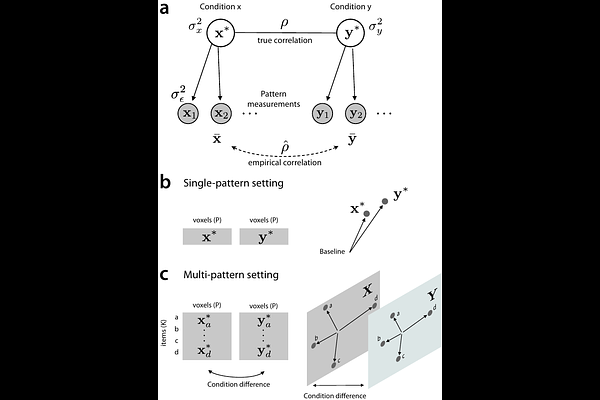
AbstractMany functional magnetic resonance imaging (fMRI) studies conclude that two conditions engage 'overlapping, yet partly distinct' patterns of activation. Yet, there is currently no commonly accepted method for determining the extent of this overlap. While correlations between activation patterns can serve as a measure of their correspondence, empirical correlations are strongly biased towards zero due to measurement noise, preventing their use in testing hypotheses about the actual degree of pattern correspondence. In this paper, we derive the maximum-likelihood estimate for the correlation of the true (noise-less) activation patterns and examine its behavior in the low signal-to-noise regime that is typical for fMRI studies. We show that although the maximum-likelihood estimate corrects for much of the influence of measurement noise, it is ultimately biased. We examine different ways of drawing inferences about the size of the underlying true correlations. We find that a subject-wise bootstrap on the maximum-likelihood group estimate performs best over the tested conditions. We extend the proposed method to test more general hypotheses about the representational geometry of activation patterns for more conditions, and highlight best practices, as well as common pitfalls and problems, in testing such hypotheses.