Temperature-dependent performance scales with maximum heat tolerance across ectotherms

Temperature-dependent performance scales with maximum heat tolerance across ectotherms
Cicchino, A. S.; Collier, J.; Bieg, C.; Davis, K.; Ghalambor, C. K.; Robey, A. J.; Sunday, J. M.; Vasseur, D.; Bernhardt, J. R.
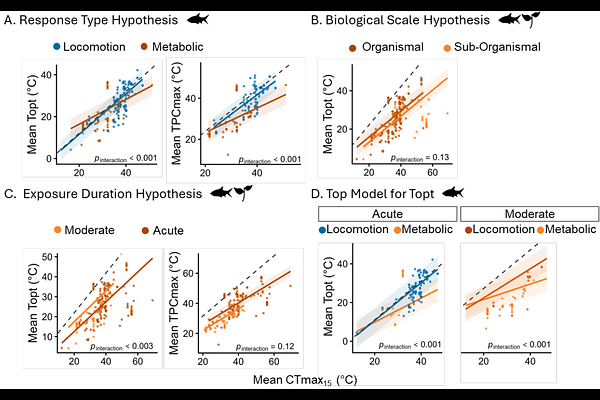
AbstractProjecting species' responses to changing temperatures remains a major challenge in ecology. Central to this effort is harnessing our understanding of species' thermal physiological traits, which underlie ectotherm fitness. These traits are typically characterized by describing performance across temperatures (thermal performance curve, TPC), and/or tolerance limits, which capture endpoints of biological failure. Despite their importance, we still lack an understanding of the functional relationship between these traits, limiting our ability to integrate them into comprehensive vulnerability assessments. Using a synthesized dataset of >100 ectotherms, we tested how tolerance (CTmax) relates to key TPC traits: thermal optima, thermal maxima, and the supra-optimal range of temperatures where performance is positive. Across taxa, TPC traits were positively related to CTmax, demonstrating a link between heat tolerance and temperature-dependent performance at sub-critical temperatures. While acute locomotor performance scaled proportionally with CTmax, metabolic processes and sustained locomotion scaled sub-proportionally, suggesting decoupling of CTmax and performance among high-CTmax species. This suggests that using CTmax as a comparative metric may overestimate thermal safety margins for metabolic processes critical to growth. Our results indicate that while CTmax and TPCs reflect shared underlying constraints--particularly in acute neuro-muscular trait--their relationship is dependent on timescale and the TPC response trait. Our findings connect our understanding of the processes that maintain performance over thermal gradients with those that cause performance to fail, improving our ability to project species persistence in a warming world.