Detection of attomolar concentration of heart-type fatty acid binding protein using ion current rectification sensing with conical SiO2 nanopores

Detection of attomolar concentration of heart-type fatty acid binding protein using ion current rectification sensing with conical SiO2 nanopores
Afrin, N.; Dutt, S.; Toimil-Molares, M. E.; Kluth, P.
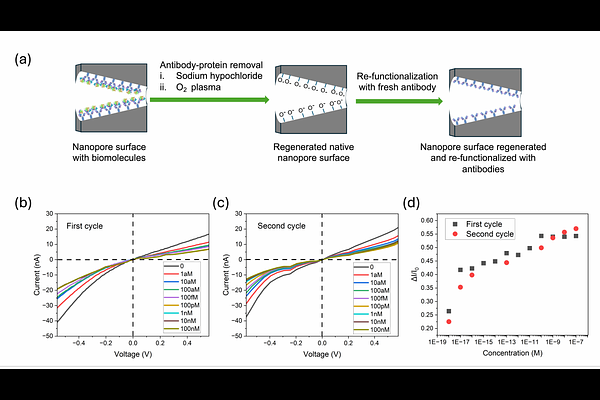
AbstractRapid and highly selective sensing of ultra-low concentration protein biomarkers remains a critical challenge important for early disease diagnosis and monitoring. Here, we use conical SiO2 nanopore-based biosensing for the rapid detection of heart-type fatty acid binding protein (H-FABP). Antibodies were covalently immobilized on the nanopore surface through siloxane chemistry. The functionalized asymmetric nanopores generate a characteristic rectifying current-voltage response, which shows a distinct shift upon binding to the target protein due to partial neutralization of the negatively charged pore surface. The sensor exhibits excellent sensitivity in the attomolar to nanomolar concentration range with a detection limit (LOD) of {approx}0.4 aM. Furthermore, the platform exhibits high selectivity, distinguishing H-FABP from non-target proteins (HSA and Hb) at concentrations six orders of magnitude higher. We also demonstrate that nanopores can be regenerated using sodium hypochloride and O2 plasma treatment, enabling repeated functionalization and reuse.