Volatile emissions from diverse estuarine bacteria share core compounds with a subset of strain-specific, low abundance compounds

Volatile emissions from diverse estuarine bacteria share core compounds with a subset of strain-specific, low abundance compounds
Galen, E.; Roslund, K.; Rinnan, R.; Riemann, L.
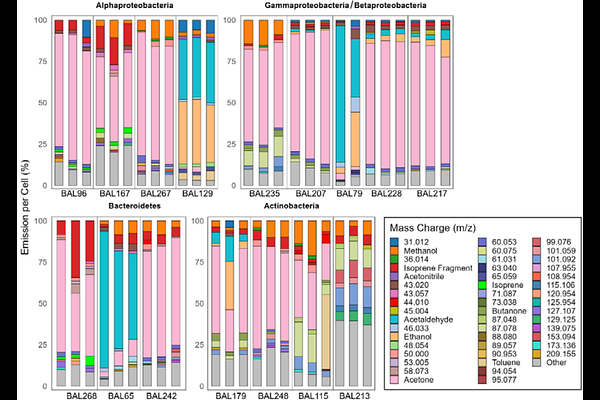
AbstractBiogenic volatile organic compounds (BVOCs) are gases that influence atmospheric chemistry, nutrient cycling, and species interactions, yet the contribution of heterotrophic marine bacteria to marine BVOC emissions remains poorly constrained. In addition, the extent to which the volatilome is linked to bacterial phylogeny is unknown. Here, we characterize the volatilome of 16 heterotrophic bacterial strains isolated from Baltic Sea surface water, spanning Alphaproteobacteria, Gammaproteobacteria, Betaproteobacteria, Bacteroidota, and Actinomycetes. Headspace BVOCs were quantified under standardized growth conditions using Proton Transfer Reaction Time-of-Flight Mass Spectrometry (PTR-TOF-MS). A broadly overlapping bacterial volatilome was identified, with compound composition and proportional abundance similar across many strains, irrespective of phylogeny. Namely, most strains shared a core set of abundant compounds with a subset of strain-specific, low abundance compounds. Acetone accounted for more than 50% of the emissions in most volatilomes. The remaining fraction of emissions were primarily comprised of other low-molecular-weight oxygenated compounds. Interestingly, two strains demonstrated strain-specific emission patterns, significantly diverging from the group in their emission rate and compound composition. Together, these findings suggest that marine heterotrophic bacteria may contribute a broadly conserved collection of BVOCs to the ocean-atmosphere interface, highlighting their role as a widespread source of trace gases in marine ecosystems.