Clade dynamics support an early origin of crown eukaryotes

Clade dynamics support an early origin of crown eukaryotes
Loron, C. C.; Rodgers, N.
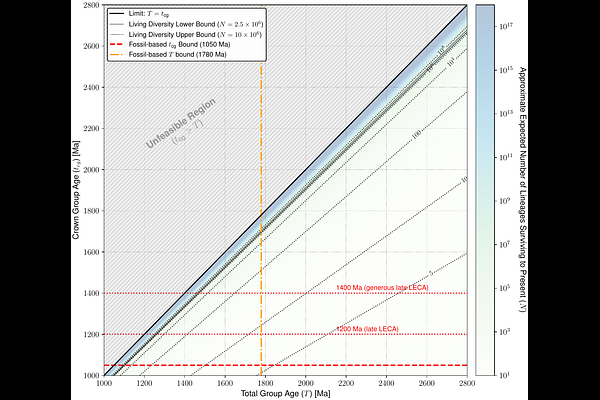
AbstractThe timing of the last eukaryotic common ancestor (LECA) remains a fundamental question in evolutionary biology and palaeontology. Unambiguous eukaryotic-grade fossils appear from 1780 Ma, but no crown-group supergroups are confidently identified before the end of the Mesoproterozoic (ca. 1050 Ma). The late LECA hypothesis suggests that this absence of crown-assignable fossils and biosignatures implies a late Mesoproterozoic origin of the crown. Here we show that this hypothesis is incompatible with the evolutionary dynamics of the eukaryote clade, even under the limited constraints of the fossil record. Studying stem-crown dynamics based on a birth-death model, we show that a late crown age requires diversification rates well below the minimum rate needed to generate observed living eukaryote diversity (2.5-10 million species) for any plausible total group age. Our results suggest that only an early LECA can bridge evolutionary dynamics with the eukaryotic-grade fossil record, the living diversity, and the molecular clock estimates. Based on these constraints, we suggest a feasible minimum age estimate for LECA of ca. 1696 Ma, supported by current fossil evidence and supporting molecular clock estimates. These results also provide a fossil-testable prediction: crown-group eukaryotes likely exist in early Mesoproterozoic assemblages, albeit undetected with current morphology-based approaches.