How robust are genomic offset predictions to methodological choices? Insights from perennial ryegrass

How robust are genomic offset predictions to methodological choices? Insights from perennial ryegrass
PEGARD, M.; LACHMUTH, S.; Sampoux, J.-P.; BLANCO-PASTOR, J.; Barre, P.; FITZPATRICK, M. C.
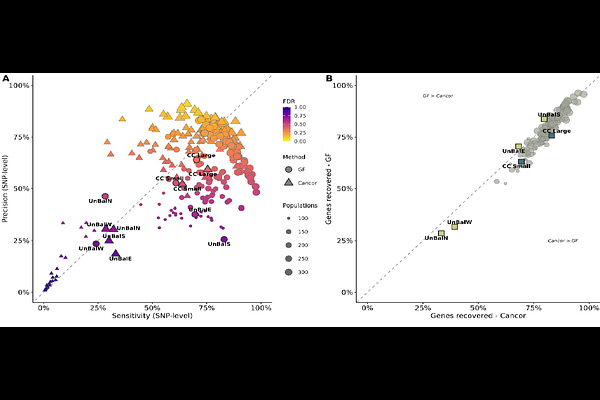
AbstractGenomic offsets are increasingly used to quantify the mismatch between a population's current genetic composition and the composition predicted under changed environmental conditions. While genomic offset is a promising tool for assessing climate maladaptation, the sensitivity of predictions to different methodological choices is not well understood. In this study, we compared two fundamentally different approaches to detect outliers before predicting genomic offsets: Gradient Forest (GF, non-linear, non-parametric) and Canonical Correlation Analysis (CANCOR, linear, parametric). To do so, we used 457 natural populations of perennial ryegrass (Lolium perenne L.), an important agricultural forage species throughout Europe. Using a data set of 189,968 SNPs and 75 climatic variables, we experimentally validated genomic offsets against 105 phenotypic traits measured across three common gardens during multiple years. We also assessed the sensitivity of outlier detection and genomic offset predictions to the number and spatial distribution of sampled populations. Both GF and CANCOR detected a substantial number of outlier loci associated with environmental gradients (2,113 and 653, respectively), with 429 loci identified by both approaches. When used to model spatial variation in genetic adaptation and estimate genomic offsets, the different outlier sets produce spatially congruent projections. We also found significant correlations between experienced genomic offset in the common garden predicted by both outlier sets and phenotypic traits, identifying traits that could serve as good fitness proxies for assessing climate risk. Analyses based on different population subsamples revealed that GF was less sensitive to sample size and geographic biases than CANCOR. Our findings provide practical guidance for designing genomic offset studies in both agricultural and natural systems and suggest that non-linear, non-paramateric methods like GF may be less sensitive to sampling design and therefore potentially more robust for predicting climate maladaptation.