Challenges and Solutions in Quantifying Brain β-Hydroxybutyrate (BHB) with 1H-MRS Following Oral Keto-Ester Consumption

Challenges and Solutions in Quantifying Brain β-Hydroxybutyrate (BHB) with 1H-MRS Following Oral Keto-Ester Consumption
Virk, M.; Conners, K. T.; Kitaneh, R.; Mignosa, M. M.; McIntyre, S.; Nixon, T. W.; DeMartini, K.; O'Malley, S.; Krystal, J. H.; De Feyter, H. M.; Angarita-Africano, G.; Mason, G. F.; de Graaf, R. A.; Kumaragamage, C.
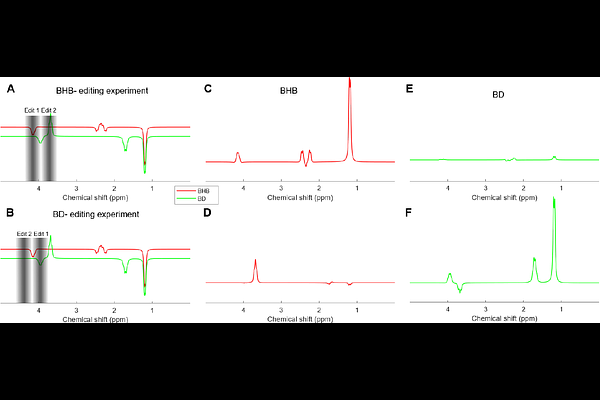
AbstractPurpose: {beta}-hydroxybutyrate (BHB), a ketone body and alternative cerebral energy substrate, can be measured in vivo using J-difference edited proton magnetic resonance spectroscopy (1H-MRS). Oral ketone supplementation with substrates such as the ketone monoester (R)-3-hydroxybutyl-(R)-3-hydroxybutyrate (KME) and 1,3-butanediol (BD) have gained attention as a mechanism to elevate circulating BHB and induce ketosis without dietary restrictions. Elevated brain ketone availability is of growing therapeutic interest as a strategy to support neuronal energetics in conditions such as epilepsy, neurodegenerative disease, and alcohol use disorder (AUD). However, both pathways introduce BD into the bloodstream, which crosses the blood-brain barrier. Critically, BD exhibits a spectral signature that closely resembles the prominent BHB peak in JDE-MR spectroscopic imaging (MRSI), identified in a pilot AUD study. Methods: Two separate JDE-MRSI acquisitions tailored for BHB and BD editing were implemented, exploiting frequency separation between the BHB (4.14ppm) and BD (3.95ppm) coupling partners of the observed 1.2ppm resonance to independently quantify each metabolite. Results: Brain BD concentrations (0.25-0.58mM) were comparable to or exceeded corresponding BHB concentrations (0.20-0.27mM) in all volunteers after consumption of a single dose of the KME, indicating that BD constitutes a major fraction of the signal conventionally attributed to BHB. Combined BHB+BD concentrations (~0.45-0.85mM) were consistent with brain BHB values reported in prior studies employing similar doses of the KME, indicating that those measurements likely reflect a combined BHB+BD signal. Conclusions: Separate quantification of the two metabolites is important for interpreting brain ketone studies and for understanding the full pharmacology of KME supplementation.