Evolutionary branching of male emergence timing: Trade-offs and variance asymmetry as drivers of dimorphism.

Evolutionary branching of male emergence timing: Trade-offs and variance asymmetry as drivers of dimorphism.
Kubo, H.; Yamaguchi, R.; Tachiki, Y.
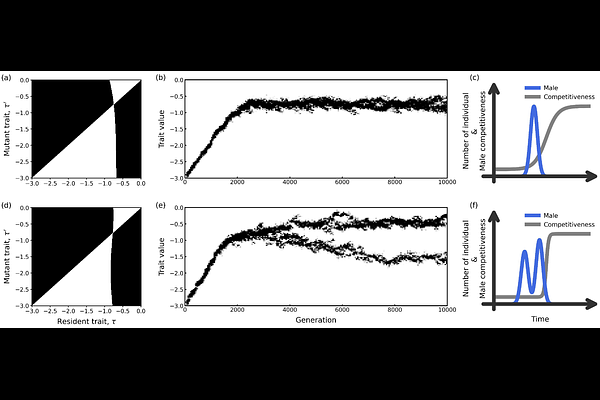
AbstractClassical models of protandry predict unimodal male emergence timing, yet empirical observations in butterflies and bees reveal dimorphism: early-emerging small males coexist with late-emerging large males. The evolutionary mechanisms underlying such discrete alternative reproductive strategies in emergence timing remain poorly understood. In this study, we developed a mathematical model using an adaptive dynamics framework to investigate the conditions under which dimorphic male emergence timing evolves. We explored two potential mechanisms: (1) a trade-off between emergence timing and male competitiveness, and (2) differences in the variance of emergence timing between the sexes. Our analysis demonstrates that both mechanisms produce evolutionary branching, and that extreme variance asymmetry between sexes can generate multiple branching events, yielding three or more distinct male clusters. These findings provide a theoretical foundation for understanding the evolution of alternative reproductive strategies in emergence timing, with implications for other systems where reproductive success depends on temporal overlap between the sexes. We provide testable predictions that a positive correlation between emergence timing and male body size or competitiveness should be observed under the trade-off mechanism, and that the variance in emergence timing within each male morph should be smaller than that of females under the variance asymmetry mechanism.