A right-hemispheric language network at single-neuron resolution

A right-hemispheric language network at single-neuron resolution
Schiffl, L. F.; Held, L. M.; Waitzmann, F.; Eder, M.; Chen, H.; Alkan, G.; Favero, P.; Utzschmid, A.; Eisenkolb, V. M.; Grosse-Wentrup, M.; Gjorgjieva, J.; Wagner, A.; Gempt, J.; Meyer, B.; Jacob, S. N.
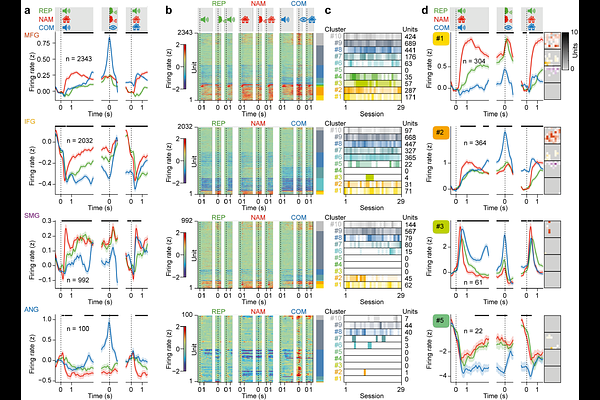
AbstractHuman language depends on highly specialized left-hemispheric brain networks. Damage to these networks causes severe language impairments (aphasia), one of the most common, debilitating and costly consequences of left-hemispheric brain injury, especially stroke. The limited recovery of aphasia despite intensive rehabilitation efforts emphasizes the need to understand the basis of residual language abilities at the single-neuron level, which has remained unexplored so far. Here, we report large-scale microelectrode recordings with single-unit resolution over a period of ten months from the right-hemispheric prefrontal and parietal association cortex of an individual with stroke-induced chronic non-fluent aphasia. Single neurons exhibited regionally specific responses during comprehension, retrieval and articulation of words, the core operations of language. Distinct subpopulations encoded linguistic information in a task-specific manner, despite correlated firing patterns across tasks. Both single-neuron activity and temporally coordinated population dynamics were predicted by semantic and phonological embeddings derived from large language models (LLMs), revealing a regional dissociation in which semantic features preferentially accounted for prefrontal activity and phonological features for parietal activity. Our findings suggest that right-hemispheric circuits, homotopic to the left language network, can support language processing through structured, functionally organised activity at the level of single neurons. This study opens an avenue for developing mechanistically specific neurorehabilitation and neurorestorative strategies for aphasia, such as brain-computer interfaces (BCIs), that leverage right-hemispheric language resources.