GAMETE maps the genetic architecture of chromatin accessibility in rice pollen at single-nucleus resolution

GAMETE maps the genetic architecture of chromatin accessibility in rice pollen at single-nucleus resolution
Liu, Y.; Xia, C.; Li, J.; Li, J.; Yang, H.; Zong, Z.; Ming, L.; Yang, J.; Lian, H.; Luo, M.; Zhu, T.; He, X.; Xing, Y.; Yu, S.; Ouyang, Y.; Xie, W.
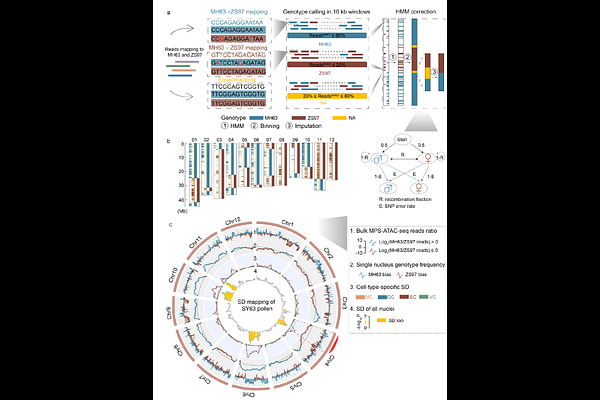
AbstractBackground Dissecting the genetic basis of cell-type-specific gene regulation during gametogenesis remains a major challenge. Population-level studies mask cellular heterogeneity, while the extreme data sparsity of single-cell profiling has precluded robust genetic mapping. Results We present GAMETE (Genetic Architecture Mapping of Epigenetic Traits at single-nucleus resolution), an integrated framework combining MPS-ATAC-seq, a high-throughput single-nucleus ATAC-seq method, with robust computational approaches for genotype inference and genetic mapping from sparse single-nucleus data. Applying GAMETE to hybrid rice pollen, we simultaneously profiled chromatin accessibility and inferred the genotypes of 4,887 individual haploid nuclei, revealing distinct chromatin landscapes across pollen cell types. This uncovered an unexpected elevation of chromatin accessibility at gypsy retrotransposons in microspores preceding their silencing in sperm cells, exposing a surveillance gap that may contribute to genome expansion. The synchronized profiling enabled us to construct a single-cell recombination map, map segregation distortion loci and trace their developmental origins, and identify 16,113 chromatin accessibility QTLs (caQTLs), 48.6% of which exhibited pronounced cell-type specificity. Analysis of introgression lines supported a cell-type-specific trans-acting caQTL regulating the pollen-essential gene DTM1. Conclusions This work establishes GAMETE as a broadly applicable framework for dissecting the genetic architecture of chromatin accessibility during gametogenesis without the need for subsequent generations.