Multidomain Analysis of Clinical Cognitive Assessments and Imaging Data in Alzheimer's Disease Accurately Predicts Disease Stage and Grade Independent of Amyloid and Tau

Multidomain Analysis of Clinical Cognitive Assessments and Imaging Data in Alzheimer's Disease Accurately Predicts Disease Stage and Grade Independent of Amyloid and Tau
Chong Chie, J. A. K. H.; Persohn, S. A.; Simcox, O. R.; Salama, P.; Territo, P. R.; for the Alzheimer's Disease Neuroimaging Initiative,
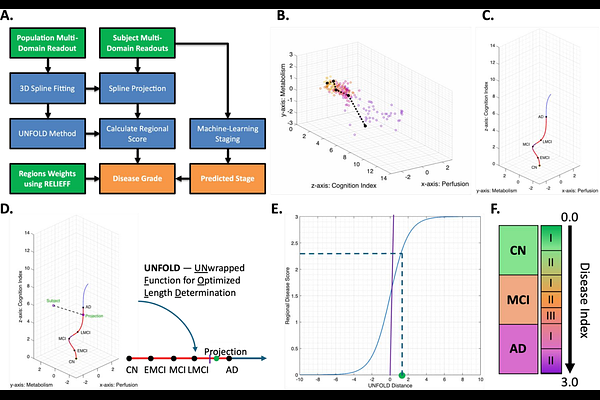
AbstractBackground Individual clinical cognitive assessments (CCA) for Alzheimer's disease (AD) provide broad disease stratification but are limited in sensitivity and specificity, requiring integration of multiple CCA for optimal disease staging. Recent work from our lab suggests that neuro-metabolic and vascular dysregulation (MVD) occurs early in AD, prior to clinical symptoms, and may provide higher sensitivity and specificity than CCA alone. In this study, we combined three widely accepted CCA with MVD readouts and developed a multimodal ensemble machine learning approach across the AD spectrum to predict disease stage and grade. Methods AD subjects (N=372) across the disease spectrum with imaging (PET:18F-FDG, MRI:T1w, T2 FLAIR, ASL) and CCAs (ADAS-Cog, CDR, MoCA) data were analyzed from ADNI. Imaging data were registered to MNI152+, z-scored relative to cognitively normal controls, and processed for MVD. A clinical-set-enrichment analysis (CSEA) was developed to link regional brain changes with CCA scores, map changes to functional categories, project them into a 3D Cartesian space, and model trajectories, thus revealing at-risk and resilient regions. In addition, an ensemble machine-learning approach was utilized for disease stage classification, and a disease grading scheme across the AD spectrum was developed to further stratify within disease stages. Findings Regional data followed an MVD pattern across AD stages stratified by CSEA scores. Females showed greater stage separation along the CCA axis within each region, indicating faster disease progression. Moreover, progression in at-risk brain regions (e.g., mid- and inf-temporal gyri, amygdala) was associated with longer disease path lengths, whereas progression in resilient brain regions (supramarginal gyrus) was not. Moreover, our classification and grading approach can predict AD stage and grade independent of amyloid-beta and tau with high precision and accuracy. Interpretation A framework was developed to evaluate MVD and CCA variations across the AD spectrum, thereby distinguishing at-risk and resilient brain regions. Distinct disease trajectories were identified, and a new data-driven grading scheme was proposed to highlight the potential for precision medicine and therapeutic evaluation. Funding NIH T32AG071444