Ultraviolet exposure remodels skin to enhance arbovirus infection and mosquito biting behaviour

Ultraviolet exposure remodels skin to enhance arbovirus infection and mosquito biting behaviour
McCafferty-Brown, A.; Keskek Turk, Y.; Alhazmi, A.; Durham, A.; Katja, L. P.; Lefteri, D.; Bryden, S. R.; Graham, G.; Shams, K.; McKimmie, C. S.
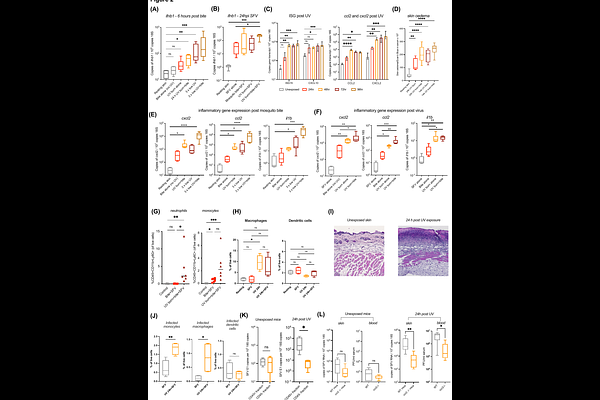
AbstractUltraviolet (UV) radiation is a pervasive environmental exposure that conditions the skin into a distinct tissue state, yet its impact on susceptibility to mosquito-borne virus infection remains unclear. We show that UV exposure establishes a temporally evolving conditioned tissue state that enhances infection and transmission potential. In mice, a single UV exposure increased virus replication, dissemination and mortality. Early after exposure, UV-driven inflammation recruits monocytes and macrophages that are preferentially infected and amplify viral load. However, this phase is transient: myeloid cells subsequently become refractory to infection, and susceptibility is instead maintained by proliferating fibroblasts generated during tissue repair, forming a durable replication niche. These findings indicate that susceptibility is a property of a UV-conditioned tissue state encoded within the stromal compartment. UV exposure also made skin warmer and increased mosquito attraction and probing behaviour. Topical corticosteroid treatment partially reduced early viraemia and neuroinflammation. Despite higher early viral loads, UV-exposed mice developed reduced neutralising activity, indicating impaired adaptive responses. Together, these findings establish UV exposure as a driver of conditioned tissue states that determine arbovirus susceptibility and identify sunlight exposure as a modifiable determinant of vector-borne disease.