Neuroprotective Effect of Intraperitoneal Humanin-G in Retinal Degeneration of Royal College of Surgeons Rats

Neuroprotective Effect of Intraperitoneal Humanin-G in Retinal Degeneration of Royal College of Surgeons Rats
Lin, B.; Schneider, K.; Ozgul, M.; Ianopol, V. N.; Seiler, M. J.
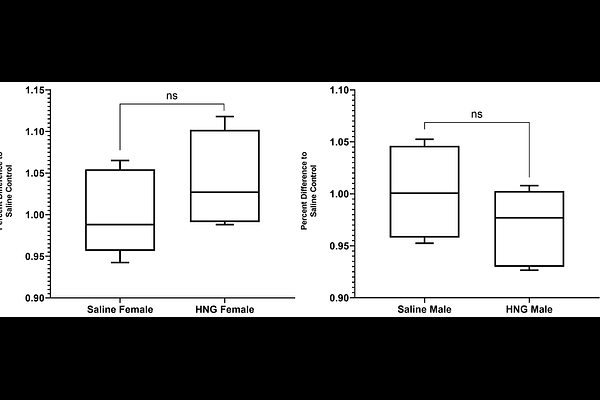
AbstractThis study aimed to examine whether Humanin-G (HNG), a mitochondrial derived peptide with cytoprotective properties, could improve the retinal function and gene expression profiles after intraperitoneal injections to Royal College of Surgeons (RCS) rats with Retinal Pigment Epithelium (RPE) dysfunction and retinal degeneration. Starting at postnatal day 21 (p21), RCS rats received twice a week intraperitoneal injections of either Low Dose HNG (0.4 mg/kg), High Dose HNG (4mg/kg), or sham-saline for 1 or 4 weeks. Visual function was tested with full field scotopic & photopic electroretinography (ERG) and optokinetic testing (OKT) 1 and 4 weeks after first injection (WAFI). The rats were euthanized after the ERG and OKT (1 or 4 WAFI) and the dissected retinas and RPE were collected for RNA, cDNA and Quantitative Real-time PCR (qRT-PCR) analysis. The results of our study showed that high dose (4mg/kg) HNG at 4 WAFI was associated with the largest change in gene expression in the RPE and retina of treated animals, altering expression of genes involved in apoptosis, oxidative stress, inflammation and retinal/RPE function. Analysis of a and b waves from scotopic and photopic ERG showed no difference between either low or high dose of HNG and sham injection at 4 WAFI. However, at 4 WAFI, the visual acuity in rats treated with high dose HNG showed significant improvement as compared to the rats treated with low dose of HNG or saline. Most significantly, our findings support that HNG administered IP can modulate RPE/neuroretina cells and improve vision, thus may be a potential treatment for retinal degeneration diseases.