Horizontal transfer of chromosomal DNA mediated by an integrative and conjugative element generates frequent localized recombination in Novosphingobium aromaticivorans

Horizontal transfer of chromosomal DNA mediated by an integrative and conjugative element generates frequent localized recombination in Novosphingobium aromaticivorans
Allemann, M. N.; Hochanadel, L.; Vasileva, D. P.; Michener, J. K.
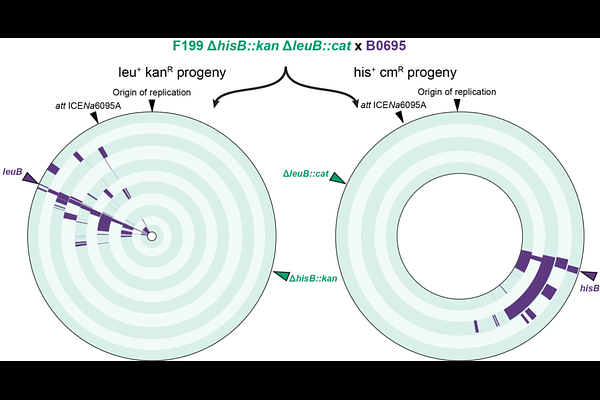
AbstractHorizontal gene transfer is an important evolutionary process by which DNA is exchanged between cells that are physically co-located but not direct evolutionary descendants. Horizontal transfer of highly divergent DNA is relatively easy to detect and can produce major phenotypic changes, exemplified by acquisition of antibiotic resistance determinants. However, transfer of high-identity DNA, for example between strains of the same species, is likely to be more frequent, harder to detect, and highly impactful in aggregate. In this work, we demonstrate that recombination between soil isolates of the alphaproteobacterium Novosphingobium aromaticivorans can exchange chromosomal DNA, leading to multiple unselected recombination events spanning approximately 10% of the chromosome. Chromosomal recombination was directional, more efficient near an integrative and conjugative element (ICE), and required a relaxase found in the ICE. Recombination could not be observed into strains from closely related Novosphingobium species. In combination, these results suggest that ICE-mediated recombination can efficiently recombine DNA within N. aromaticivorans, increasing the adaptive potential of the species while also enforcing species boundaries through preferential intraspecific recombination.