Liquid-solid phase transitions in the biological condensates of a conserved mitotic spindle regulator

Liquid-solid phase transitions in the biological condensates of a conserved mitotic spindle regulator
Parra, A. S.; Johnston, C. A.
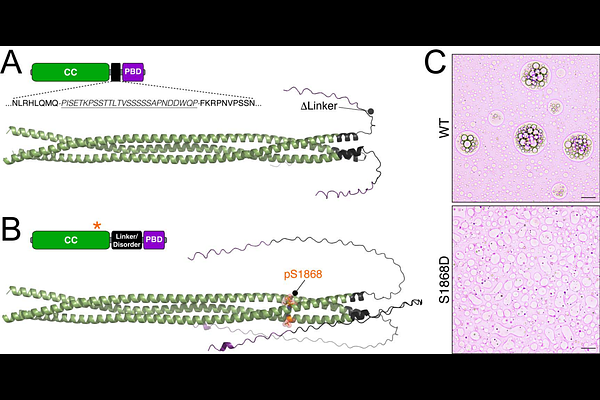
AbstractFormation of biological condensates through phase separation has emerged as a means of discrete subcellular organization permitting regulatory precision across diverse processes. We recently found that the conserved mitotic spindle positioning complex of Mushroom body defect (Mud) and Partner of Inscuteable (Pins) phase separates into condensates with dynamic, liquid-like properties. While the Mud/Pins complex functions at the cell cortex in diverse cell types, Mud also controls centrosome activity independently of Pins at spindle poles. Here we find that Mud alone undergoes homotypic phase separation, producing condensates with characteristics unique from those of the heterotypic Mud/Pins complex. Specifically, Mud condensate droplets display a less dynamic behavior with reduced propensity for liquid-like fusions. Instead, they coalesce into larger aggregates of otherwise individual droplets, resulting in liquid-to-solid phase transitions over time. Structural modeling and mutational analyses implicate self-interacting oligomerization as a possible molecular model for this condensate behavior. Phosphorylation of Mud by the mitotic kinases, Warts or Polo-like kinase (Plk1), results in highly liquid-like condensates that fail to undergo phase transition. Lastly, we describe similar yet distinct solid formations in two additional spindle pole proteins, TACC and NudE, implicating an underlying common role for coiled-coil domains in these phenomena. Our studies identify new biophysical aspects of Mud function and highlight a role for phase transitions in the biological condensates of spindle-associated coiled-coil proteins.