Hippocampal CA3 forms a two-layer network of molecularly distinct cell types in mice and humans

Hippocampal CA3 forms a two-layer network of molecularly distinct cell types in mice and humans
Morse-Mora, R. J.; Ben-Simon, Y.; Arcot Jayaram, S.; Rössler, K.; Jonas, P.; Watson, J. F.
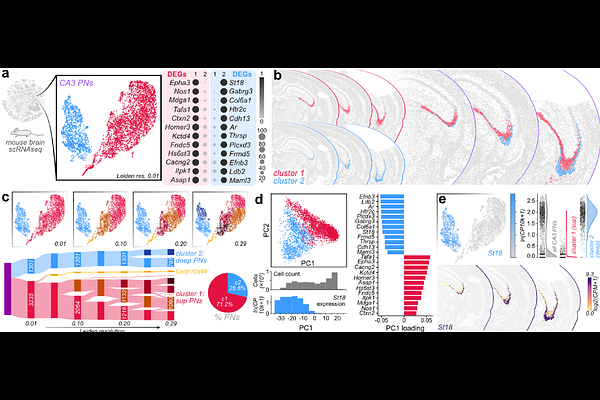
AbstractAssociational memory is critically dependent on the CA3 recurrent circuit, at the centre of the hippocampal system. While diversity amongst CA3 pyramidal neurons (PNs) has been long reported, the principles organising cell type identity and their consequences for circuit function remain unclear. Here, we demonstrate that deep-superficial is the primary axis of heterogeneity in CA3. PNs segregate into two molecularly distinct subtypes, superficial St18-, and deep St18+ neurons, with distinct anatomical, molecular, and functional properties. Using an St18-Cre mouse line, we reveal that these subtypes have divergent wiring patterns. Superficial neurons form the canonical broad autoassociative network across hemispheres and project to CA1, while deep St18+ PNs form a strikingly distinct, CA3-restricted, and predominantly unilateral projection -- a previously unrecognised circuit module embedded within the hippocampal associative network. This anatomical and molecular organisation is conserved across mammals, including mice, pigs, and humans, where patch-clamp recording in human tissue demonstrates conserved functional hallmarks of each PN subtype. Together, these findings fundamentally revise the hippocampal CA3 circuit map, revealing it as two highly distinct circuit elements and providing the molecular tools to dissect the contribution of each layer to hippocampal computation and cognition.