A Fungal Natural Product that Targets Cellulose Synthase Complex and Inhibits Plant Cellulose Biosynthesis

A Fungal Natural Product that Targets Cellulose Synthase Complex and Inhibits Plant Cellulose Biosynthesis
Wu, Z.; Liu, L.; Han, W.; Cai, X.; Xiao, P.; Sun, Z.; Yan, C.; Reid, S.; Chen, Y.; Ma, Z.; Tang, Y.; Jacobsen, S. E.
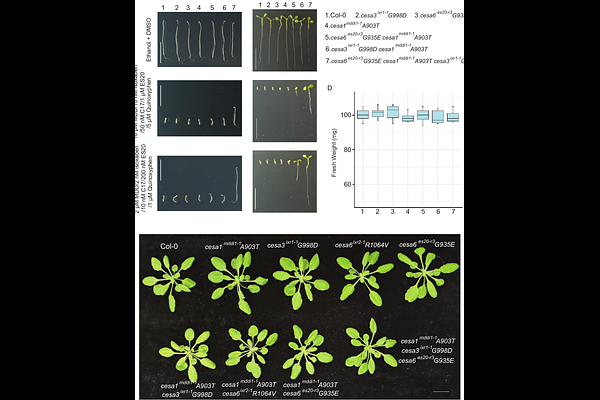
AbstractCellulose, a primary component of plant cell walls, is synthesized by cellulose synthase complexes (CSCs) at the plasma membrane. Targeting this process with cellulose biosynthesis inhibitors (CBIs) has significantly advanced our understanding of plant cell wall formation and provided valuable compounds for herbicide development. Here, we identified a fungal natural product, 8-methyldichlorodiaporthin (MDD), as a broad-spectrum plant CBI. Structure-activity relationship analyses demonstrate that methylation modifications on the isocoumarin ring and chlorination of side chain are crucial for MDD-induced growth inhibition. A chemical forward genetic screen in Arabidopsis thaliana revealed two semi-dominant CESA1 mutations, A903T and H1024Y, that confer insensitivity to MDD. Both mutations locate to transmembrane domains of CESA1, and we show that MDD depletes CSCs from the plasma membrane and reduces cellulose content. Further genetic analyses indicate that the cesa1mddi1-1 A903T mutant also confers resistance to CBIs quinoxyphen and C17, but not to CBIs isoxaben, indaziflam, or ES20. Stacking additional point mutations conferring resistance to other CBIs, cesa6ixr2-1 R1064W, and cesa6es20-r3 G935E into the cesa1mddi1-1 A903T background yields multiple-drugs resistant lines that maintain normal growth. These findings establish MDD, as a novel, natural CBI that targets CESA1, thereby extending our understanding of CSC regulation and developing multi-drugs resistant crop varieties. These findings offer new perspectives for weed management and plant biotechnology.