How Visual Context Influences Lateral Stepping Regulation While Walking on Winding Paths

How Visual Context Influences Lateral Stepping Regulation While Walking on Winding Paths
Render, A. C.; Singh, T.; Cusumano, J. P.; Dingwell, J. B.
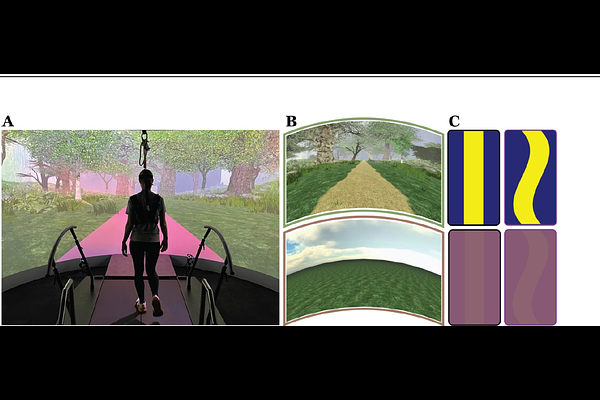
AbstractGoal-directed walking involves regulating foot placements to achieve specific tasks. This requires visuomotor integration. Perceptual, cognitive, and contextual salience guide attention and motor planning for navigation. Here, we quantified how perceptual salience informs lateral foot placement while walking. Participants walked along prescribed virtual paths (straight or winding), thus keeping contextual salience (the task itself) constant. We manipulated perceptual salience by systematically altering environment richness (rich vs. sparse) and path color contrast (high vs. low). We thus tested the extent to which stepping control is determined only by the walking path (i.e. its shape), or is also influenced by task-relevant salience of the paths (only), and/or the salience of the surrounding environment. We quantified head pitch angle to approximate gaze direction. We quantified lateral stepping regulation from a Goal Equivalent Manifold framework. On winding (vs. straight) paths, participants looked down more (lower mean head pitch) and more consistently (less variable head pitch). They took narrower, more variable steps and corrected stepping errors more strongly. This confirmed the predominant influence of task (contextual salience) on stepping control. On low (vs. high) contrast paths, participants looked down more and exhibited greater variability in lateral position on their path with weaker error correction. Higher contrast paths elicited stronger and more consistent stepping control. Walking in sparse (vs. rich) environments yielded somewhat less consistent, but still significant changes in head pitch and stepping regulation. Salience manipulations affected stepping differently on straight versus winding paths. Therefore, perceptual salience influences step-to-step control during naturalistic walking.