Fine-scale movements and habitat use of fish in intermittent rivers: Behavioural insights from drying refuge pools

Fine-scale movements and habitat use of fish in intermittent rivers: Behavioural insights from drying refuge pools
Jolles, J. W.; Gismann, J. W.; Cornet Sanz, A.; Bonada, N.
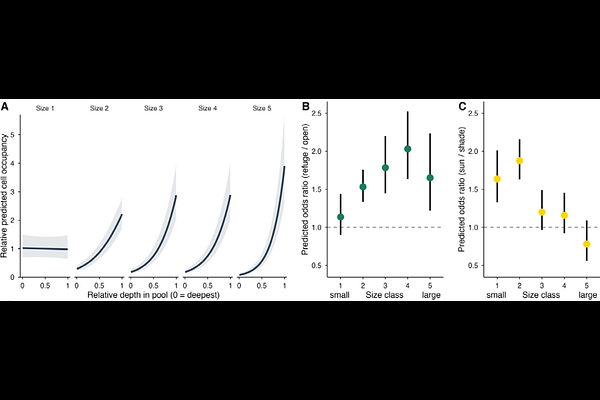
AbstractIntermittent rivers and ephemeral streams (IRES) are increasingly recognised as ecologically important freshwater systems, yet little is known about how fish behave during the critical disconnected-pool phase, when drying confines them to isolated refuge pools. We combined high-resolution orthomapping and depth reconstructions with repeated whole-pool observations and focal follows to quantify microhabitat use and fine-scale movements of fish in refuge pools of an intermittent Mediterranean river. Fish used only a small fraction of the available pool area and consistently preferred deeper, refuge-associated microhabitats. Body size strongly structured behaviour: fry and small juveniles concentrated in shallow margins and showed short, tortuous movements, whereas larger individuals occupied deeper, more structured areas, moved farther, and were more closely associated with refuges. These patterns were broadly similar in drying and non-drying pools and changed little as water levels declined. After rewetting, fish showed reduced activity and weaker depth-biased habitat use, revealing that drying history leaves carry-over imprints on behaviour even after water levels recover. Our results show that refuge pools are not homogeneous water bodies, but internally structured habitats whose fine-scale characteristics shape how fish cope with drying, underscoring their conservation importance in increasingly intermittent rivers.