Characterizing the endopeptidase activity of Candida albicans Gpi8, a crucial subunit of the GPI transamidase

Characterizing the endopeptidase activity of Candida albicans Gpi8, a crucial subunit of the GPI transamidase
Cherian, I.; Shefali, S.; Maurya, D. S.; Khan, F. M.; Komath, S. S.
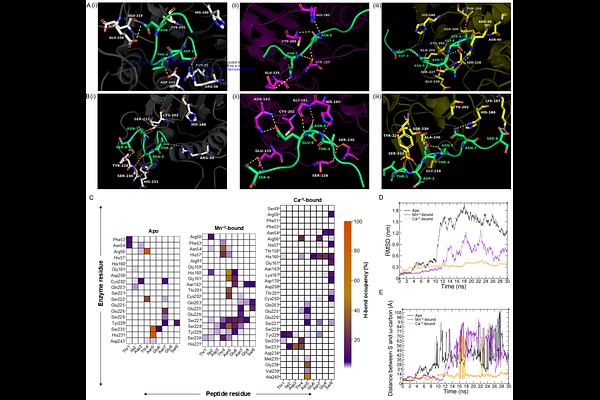
AbstractGPI-anchored proteins are crucial cell surface proteins with diverse, organism-specific functions, in eukaryotes. They are produced when the GPI transamidase (GPIT), a five-subunit membrane-bound enzyme complex, attaches a pre-formed GPI anchor to the C-terminal end of nascent proteins on the lumenal face of the endoplasmic reticulum. This process requires the removal of a C-terminal signal sequence (SS) on the substrate protein by the action of an endopeptidase subunit of the GPIT, Gpi8/ PIG-K. Using an AMC-tagged peptide in a cell free (post-mitochondrial fraction) assay, this manuscript studies the steady state kinetics of enzymatic cleavage of the substrate by GPIT of the human pathogenic fungus, C. albicans. We show that Mn+2 enhances activity by improving substrate binding but plays no direct role in substrate cleavage per se. Molecular dynamics simulations suggest that the divalent cation binds at a site away from the active site but provides compactness and stability to Gpi8. It also enables a conformation in which a flexible loop (219-244 residues) in the vicinity of the catalytic pocket is able to interact with and position the scissile bond for cleavage by Cys202. Steady state kinetics also indicate that peptides of lengths 7-mer to 9-mer are better bound than 4-mer or 15-mer peptide substrates. A bulky residue at the site of cleavage reduces the catalytic activity of the GPIT. This is the first detailed steady state kinetics study on the endopeptidase activity of a GPIT from any organism.