Number-Space Association in Macaques

Number-Space Association in Macaques
Annicchiarico, G.; Belluardo, M.; Vallortigara, G.; Ferrari, P. F.
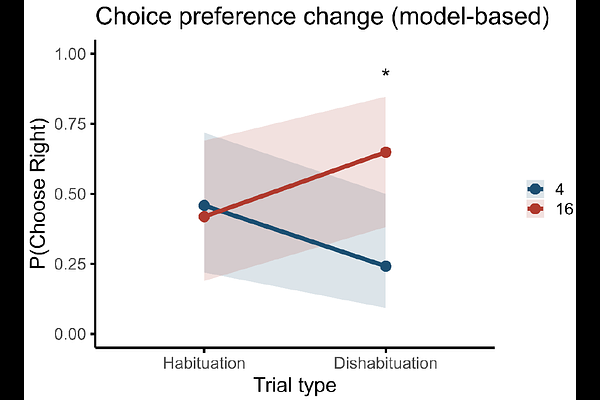
AbstractHumans order numbers in space from left to right, with smaller quantities represented preferentially in the left hemispace and larger ones in the right hemispace. The direction of this mental number line (MNL), or more generally of number space associations (NSA), is influenced by cultural habits such as reading and writing direction. However, a growing body of evidence from preverbal infants and non human animals suggests that number space mappings may also have biological foundations. In non-human primates, evidence for a directional MNL remains mixed, partly due to small sample sizes and methodological heterogeneity. Here, we tested samples of rhesus (Macaca mulatta) and crab-eating macaques (Macaca fascicularis) across two experiments using spontaneous food related tasks. In Experiment 1, monkeys chose between identical food quantities (1 to 24) presented on the left and right. No systematic spatial choice bias emerged as a function of numerical magnitude, and hand use did not differ across exact numerical pairs, although exploratory analyses revealed magnitude-related modulations of manual responses. In Experiment 2, monkeys were habituated to small (4) or large (16) quantities and subsequently tested with the alternative quantity. Result showed significantly more leftward choices following numerical decreases and more rightward choices following numerical increases, indicating that relative numerical context, rather than absolute magnitude, elicited directional spatial biases. These findings suggest that in macaques, number space associations emerge most robustly in comparative contexts involving expectancy violations of magnitude.