Motor learning under mental fatigue: the compensatory role of rest periods

Motor learning under mental fatigue: the compensatory role of rest periods
Ruffino, C.; Jacquet, T.; Lepers, R.; Papaxanthis, C.; Truong, C.
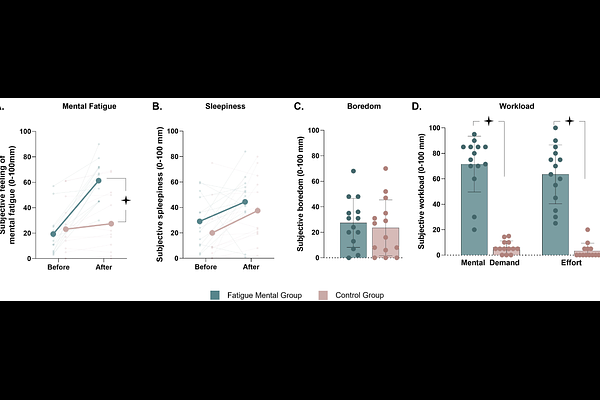
AbstractMental fatigue is known to impair cognitive and motor performance, but its impact on motor learning remains unclear. This study examined how mental fatigue affects skill acquisition in a sequential finger-tapping task. Twenty-eight participants were assigned to either a mental fatigue group, which completed a thirty-minute Stroop task, or a control group, which watched a documentary of equivalent duration. Both groups then trained on the finger-tapping task across multiple practice blocks with brief rest periods. Overall motor skill improved similarly in both groups. However, mental fatigue altered the pattern of acquisition: participants in the fatigue group showed decreased performance during practice blocks, which was compensated by larger gains during inter-block rest periods. A strong negative correlation was observed between online decrements and offline improvements, indicating that greater declines during practice were associated with larger gains during rest. This study highlights the critical role of rest periods in maintaining learning under cognitively demanding conditions and provides insight into how internal states, such as mental fatigue, can selectively influence the expression of performance without compromising overall learning.