The submergence-induced drastic morphological plasticity of root in the amphibious plant Callitriche palustris

The submergence-induced drastic morphological plasticity of root in the amphibious plant Callitriche palustris
Sato, T.; Doll, Y.; Kojima, M.; Takebayashi, Y.; Takeuchi, J.; Todoroki, Y.; Sakakibara, H.; Koga, H.; Tsukaya, H.
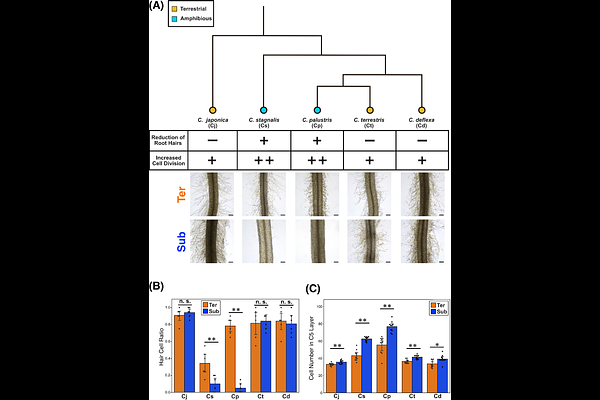
AbstractAmphibious plants can thrive in both terrestrial and submerged environments, which are fundamentally distinct. Although morphological plasticity of leaf known as heterophylly has been well investigated, the morphological plasticity of root in amphibious plants remains poorly understood. In this study, we discovered that an amphibious plant Callitriche palustris (Plantaginaceae), which has significant heterophylly, has a remarkable morphological plasticity also in root in response to submergence. This species develops thin roots with abundant root hairs, fewer cortical and epidermal cells, and smaller aerenchyma in the terrestrial condition. On the other hand, it develops thicker roots with few root hairs, more cortical and epidermal cells, and larger aerenchyma in the submerged condition. We call this morphological plasticity of root as "heterorhizy". Phytohormone perturbation experiments revealed that abscisic acid (ABA) and gibberellin regulate root hair development and root cell division respectively. We also found the possibility that heterorhizy was acquired in the genus Callitriche. Additionally, a similar form of root hair plasticity was also observed in the phylogenetically distinct amphibious species Ludwigia arcuata (Onagraceae). Furthermore, the absence of root hair development underwater and the similar structure of aerenchyma to C. palustris were broadly seen across diverse aquatic plants. This study provides new insights into the root morphological responses to submerged environments in aquatic plants.