Convergent natural selection at both ends of Eurasia during parallel radical lifestyle shifts in the last ten millennia

Convergent natural selection at both ends of Eurasia during parallel radical lifestyle shifts in the last ten millennia
Barton, A. R.; Rohland, N.; Mallick, S.; Pinhasi, R.; Akbari, A.; Reich, D.
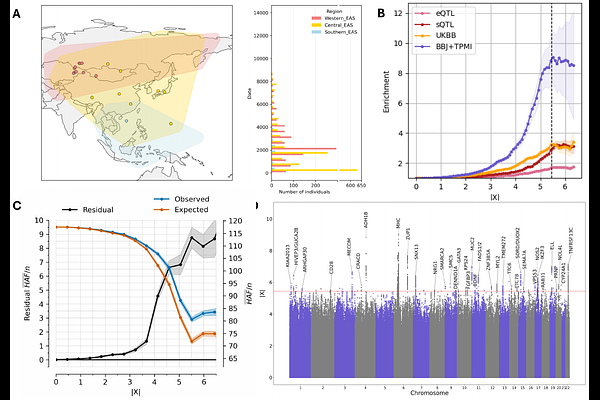
AbstractAncient DNA-based studies of natural selection have focused on West Eurasia due to the availability of large sample sizes, but rich insights are expected to come from comparative studies that can reveal which patterns are shared and which region-specific. We test around seven million variants for selection in 1,862 ancient East Eurasians (867 with new data) distributed over the last ten millennia. Using a generalized linear mixed model to control for population structure, we identify 40 genome-wide significant signals of selection, which have a particularly strong impact on immune and cardiometabolic traits just as in West Eurasia. East and West Eurasia show highly correlated signals of adaptation both for individual alleles and for complex traits, showing how these geographically separate groups experienced convergent evolution in response to parallel transitions to food producing economies and the accompanying lifestyle changes. An exception is the genetic determinants of light skin color: West Eurasians depigmented in the last 10,000 years, but most skin lightening in East Asians arose prior to the Holocene.