miR319 promotes de novo shoot regeneration by repressing LsTCP4 in lettuce

miR319 promotes de novo shoot regeneration by repressing LsTCP4 in lettuce
Jiang, T.; Tanwir, S. E.; Karn, A.; Liu, F.; Huo, H.
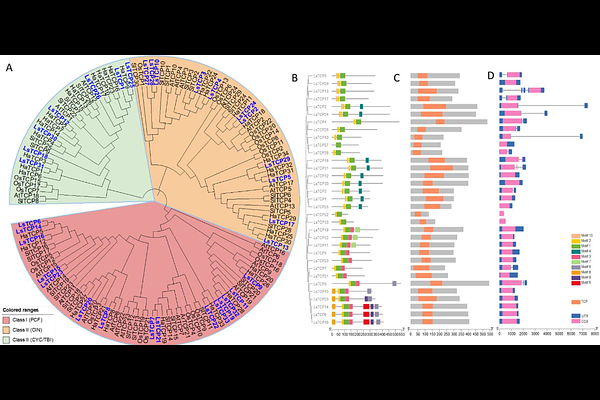
AbstractPlant regeneration is a major determinant of transformation and genome-editing efficiency, yet the endogenous regulatory networks controlling regenerative competence in horticultural crops remain incompletely understood. The miR319-TCP module regulates multiple developmental processes in plants, but its function in lettuce regeneration has not been defined. Here, we performed a genome-wide analysis of the TEOSINTE BRANCHED1/CYCLOIDEA/PROLIFERATING CELL FACTOR (TCP) gene family in lettuce (Lactuca sativa). Thirty-three LsTCP genes were identified and classified into Class I/PCF, Class II/CIN, and Class II/CYC/TB1 groups. Five CIN-class genes, LsTCP2, LsTCP3, LsTCP4, LsTCP10, and LsTCP24, were predicted as high-confidence miR319 targets and supported by degradome-based cleavage evidence. MIR319-overexpression (OX319) explants showed enhanced de novo shoot regeneration, with 94.5% regeneration efficiency and 1.92 shoots per explant, whereas STTM-miR319 suppression (S319) explants showed reduced regeneration, with 28.5% regeneration efficiency and 0.36 shoots per explant. These phenotypes were associated with altered expression of several miR319-targeted CIN-TCP genes, particularly LsTCP4, LsTCP10, and LsTCP24. Disruption of LsTCP4 increased regeneration efficiency to 91.4% and shoot production to 2.05 shoots per explant, resembling the regeneration-enhancing effect of miR319 overexpression. In contrast, disruption of the non-target CIN gene LsTCP17 did not significantly affect regeneration under the tested conditions. Together, these results identify LsTCP4 as a key miR319-responsive negative regulator of de novo shoot regeneration and highlight miR319-mediated repression of LsTCP4 as a potential endogenous strategy for improving lettuce regeneration.