Transcranial magnetic stimulation to frontal cortex, unlike occipital stimulation, does not disrupt exogenous attention

Transcranial magnetic stimulation to frontal cortex, unlike occipital stimulation, does not disrupt exogenous attention
Chen, Q.; Lee, H.-H.; Hanning, N. M.; Carrasco, M.
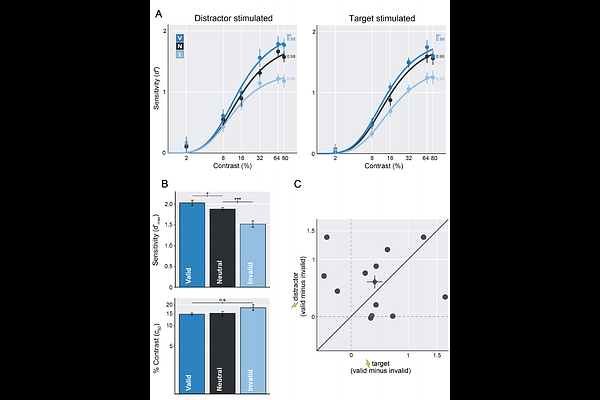
AbstractOrienting covert attention to a target location improves performance across a wide array of visual tasks [1, 2]. Whereas fMRI studies have identified partially overlapping frontoparietal networks underlying endogenous (voluntary) and exogenous (involuntary) covert attention, these correlational methods cannot establish whether a given region is functionally necessary. Prior neurostimulation studies have established that early visual cortex (V1/V2) is critical for exogenous [3, 4] but not endogenous attention [5], whereas the right frontal eye field (rFEF+) is critical for endogenous attention [5]. Here, we used a combined psychophysical-TMS protocol to investigate whether rFEF+ is also required for exogenous attention. Participants performed an orientation discrimination task, in which a peripheral cue (valid, neutral, or invalid) preceded a target and a distractor stimulus. We applied two successive TMS pulses to rFEF+ during stimulus presentation and measured contrast-response functions (CRFs) to quantify perceptual sensitivity (d') across all attention cueing and stimulation conditions. When the distractor was stimulated, exogenous attention yielded a characteristic response gain at the target, with performance benefits for valid cues and costs for invalid cues at high contrast levels. Crucially, this response gain was entirely preserved when the target was stimulated. This pattern contrasts with previous findings demonstrating that TMS to V1/V2 eliminates exogenous attentional effects at the stimulated location. These results indicate that rFEF+ is not necessary for exogenous attention, and together with previous studies [3-5] complete a double dissociation: rFEF+ is critical for endogenous but not exogenous attention, whereas V1/V2 is critical for exogenous but not endogenous attention. These findings reveal a distinct causal cortical architecture for voluntary and involuntary spatial attention, suggesting that they rely on different cortical scaffolds.