Dopamine Abundance Uncouples Neurodegeneration and Lifespan in a C. elegans Model of Parkinson's Disease

Dopamine Abundance Uncouples Neurodegeneration and Lifespan in a C. elegans Model of Parkinson's Disease
Willicott, C. W.; Altman, T. J.; Kimble, L. C.; Berkowitz, L. A.; Caldwell, G. A.; Caldwell, K. A.
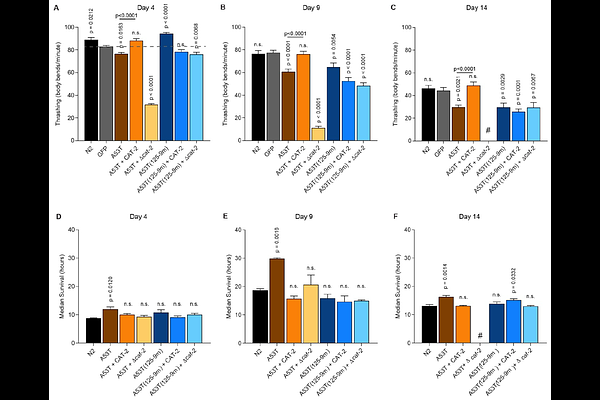
AbstractThe neuropathology of Parkinson's disease is characterized by -synuclein (-syn) aggregation and dopaminergic (DAergic) neurodegeneration. While neuronal loss in C. elegans -syn-induced neurodegeneration models is temporally age-dependent, prior research indicates it is uncoupled from the organismal aging process. Here we examined transgenic C. elegans expressing human A53T -syn in DAergic neurons to determine the impact of localized DA metabolism on both neurodegeneration and organismal lifespan. Increasing endogenous DA levels through overexpression of tyrosine hydroxylase (CAT-2) exacerbated A53T-induced DAergic degeneration, whereas DA depletion via{Delta} cat-2 mutation rescued neuronal survival. By mutating a DA interaction motif within -syn, neurodegeneration was rendered insensitive to DA manipulation, thus confirming a structural basis for in vivo toxicity. We identified a DA--syn interaction that acts as a common upstream bridge whereby localized stress induces physiological responses in C. elegans. Genetically, this biochemical interaction acts as a pleiotropic trigger driving two compartmentalized responses: localized DAergic neurodegeneration via oxidative stress, and organism-wide, TFEB/hlh-30-dependent proteostatic remodeling that extends lifespan. Modulating autophagy, without exacerbating DA-mediated oxidative stress, represents a promising strategy to preserve adaptive systemic remodeling while limiting targeted neuronal damage.