The luminal and cytosolic domains of CLIMP-63 cooperate to set ER sheet width

The luminal and cytosolic domains of CLIMP-63 cooperate to set ER sheet width
Samurkas, A.; Abrami, L.; Kunz, B.; Ho, S.; Dal Peraro, M.; Mesquita, F. S.; van der Goot, F. G.
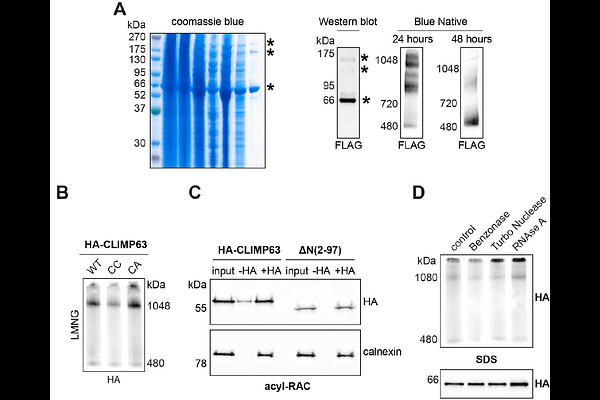
AbstractThe endoplasmic reticulum (ER) synthesized and folds secreted and transmembrane protein in regions composed of flattened sheets with a defined luminal width of [~]50 nm. CLIMP-63 has been proposed to be the principal determinant of this spacing, but the molecular mechanism by which it controls luminal width remains unclear. The luminal domain of CLIMP-63 has been proposed to act as a fixed-length spacer through antiparallel coiled-coil dimerization between molecules on opposing membranes. Here we revise this model. Using systematic cysteine trapping across the luminal domain, we demonstrate that CLIMP-63 assembles into parallel trimers. An AlphaFold-guided screen of CLIMP-63 orthologs combined with cryo-electron microscopy reveals that the luminal domain forms an elongated trimeric rod with intrinsic conformational flexibility at hinge regions. This flexibility is functionally required: replacing the human luminal domain with a more rigid ortholog causes complete ER vacuolation. Higher-order assembly of CLIMP-63 trimers beyond the trimer depends on the cytosolic tail rather than on luminal trans interactions, and the tails role in higher order assembly is separable from its other architectural functions. Together, these findings show that luminal trimeric extension and cytosolic tail-mediated clustering cooperate to determine ER sheet width.