Low-abundance αSyn-112 promotes αSyn-140 aggregation in vitro and forms immunoreactive deposits in Parkinson's disease brain tissue

Low-abundance αSyn-112 promotes αSyn-140 aggregation in vitro and forms immunoreactive deposits in Parkinson's disease brain tissue
Röntgen, A.; Fusco, G.; Breiter, J.; Beckwith, J. S.; Lachica, J.; Toomey, C. E.; Singh, J.; Klementieva, O.; Gandhi, S.; Lee, S.; De Simone, A.; Toprakcioglu, Z.; Vendruscolo, M.
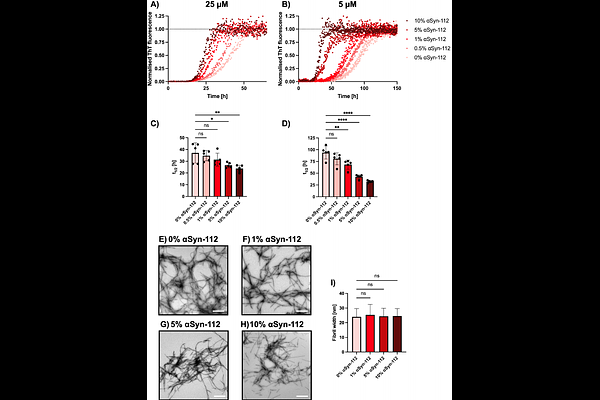
AbstractThe aggregation of -synuclein (Syn) is a molecular hallmark of Parkinson's disease (PD) and other synucleinopathies. Understanding the molecular mechanisms that determine the aggregation of this protein may thus facilitate the development of disease-modifying therapies. While Syn is most commonly expressed as a 140-residue protein (Syn-140), recent evidence suggests an involvement of alternatively spliced Syn isoforms in disease onset and progression. Here, we report and characterise the interaction between Syn-140 and the aggregation-prone Syn-112 variant, one of the most abundant Syn splice isoforms. We found that amounts as low as 1% of Syn-112 accelerate the nucleation and aggregation of Syn-140. To further investigate this phenomenon, we employed MALDI-MS and NMR spectroscopy, confirming that Syn-140 and Syn-112 monomers interact strongly with one another. Furthermore, to assess the association of Syn-112 with disease pathology, we performed immunohistochemical staining combined with confocal microscopy on PD brain samples. Thereby, we found an increase in the number as well as the area of Syn-112 immunoreactive aggregates compared to healthy controls. These results illustrate how low-abundance Syn splice isoforms can modulate the aggregation landscape of Syn-140 and in turn contribute to the molecular heterogeneity of synucleinopathies.