Tartrazine clears live cells while preserving viability at high refractive indices and osmolality

Tartrazine clears live cells while preserving viability at high refractive indices and osmolality
Hou, X.; Cai, S.; Cui, H.; Liu, Z.; Zhao, S.; Zhang, L.-Y.; Baghdasaryan, A.; Crunkleton, V.; Brongersma, M.; Hong, G.
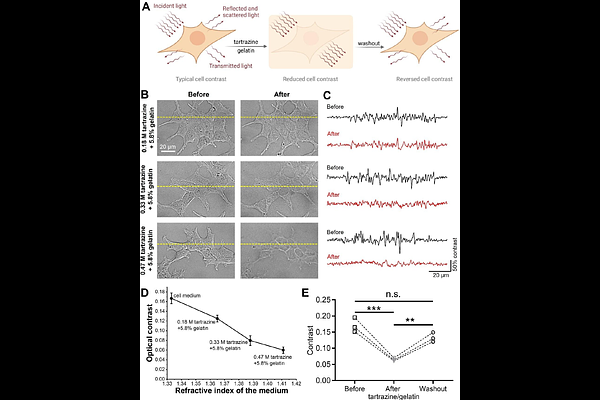
AbstractTissue-clearing techniques have transformed optical imaging of fixed specimens, yet their application to living systems remains limited by toxicity and removal of key tissue components. We recently demonstrated that absorbing molecules such as tartrazine can reversibly render live mouse skin transparent. Subsequently, it was reported that isotonic protein solutions can achieve ex vivo and in vivo cellular clearing. However, discrepancies remain regarding the optimal refractive index (RI) for live-cell clearing and the impact of elevated osmolality on cell viability. Here, using cultured mammalian cells, we systematically examine the dependence of optical contrast on medium RI and the effects of hyperosmolality. We find that, contrary to the recent report of an optimal RI of 1.36~1.37 for suspended cells, densely-packed adherent cells exhibit a monotonic increase in transparency up to an RI of 1.41 with tartrazine. Moreover, even under highly hyperosmotic conditions (~1200 mOsm/kg), cultured cells exhibit minimal deformation and negligible loss of viability for up to 30 min in the clearing solution. These results demonstrate that tartrazine enables effective live-cell clearing at RI up to 1.41 while preserving viability under elevated osmolality, and motivate future studies to define optimal conditions for in vivo optical clearing.